
China's Quadruped Robot Industry in 2026: A Complete Guide for Global Buyers, Investors, and Partners
A decade ago, a robotic dog doing a backflip on YouTube felt like science fiction. Today, that same technology is inspecting power substations in Zhejiang, patrolling petrochemical plants in Shandong, and carrying thermal cameras through fire-gutted buildings — and the companies building it are mostly Chinese. If you are a buyer, distributor, investor, or strategic partner trying to make sense of this fast-moving market, here is what you actually need to know.
1. From Lab to Loading Dock: A Decade in Motion
It is easy to forget how quickly this industry moved. Boston Dynamics unveiled Spot Classic in 2015, and for several years quadruped robots were largely treated as a carnival trick — flashy, expensive, and fundamentally a research project. Chinese teams were watching closely. Wang Xingxing, a young engineer then fresh out of Shanghai University, founded Unitree in Hangzhou in 2016 and shipped Laikago, China's first commercially available high-performance quadruped, the following year. A cluster of other startups — DEEP Robotics (云深处), founded by Zhejiang University researchers in 2017, being the most prominent — began to form around the same time.
Unitree releases Laikago; DEEP Robotics is founded in Hangzhou. Prices are high (tens of thousands of dollars); buyers are almost exclusively university labs.
Unitree launches Go1 at consumer-friendly price points; Xiaomi shows CyberDog. Unitree's machines appear on national TV (Spring Festival Gala, Beijing Winter Olympics), raising public awareness.
DEEP Robotics deploys the first fully autonomous substation inspection dogs with State Grid; Micro Robotech (具微科技) enters explosion-proof industrial niches; GENISOM AI (智身科技) spins out of Xiaomi's CyberDog team.
Unitree hits RMB 1.699 billion in revenue; DEEP Robotics turns its first full-year profit; AGIQUAD (智元酷拓) is spun off from AGIBOT to focus on industrial quads. Global annual shipments reach roughly 46,000 units.
Unitree lists on Shanghai's STAR Market in August; DEEP Robotics files for its own IPO. Professional applications outpace consumer growth by a wide margin.
2. The 2026 Market at a Glance: The Numbers That Matter
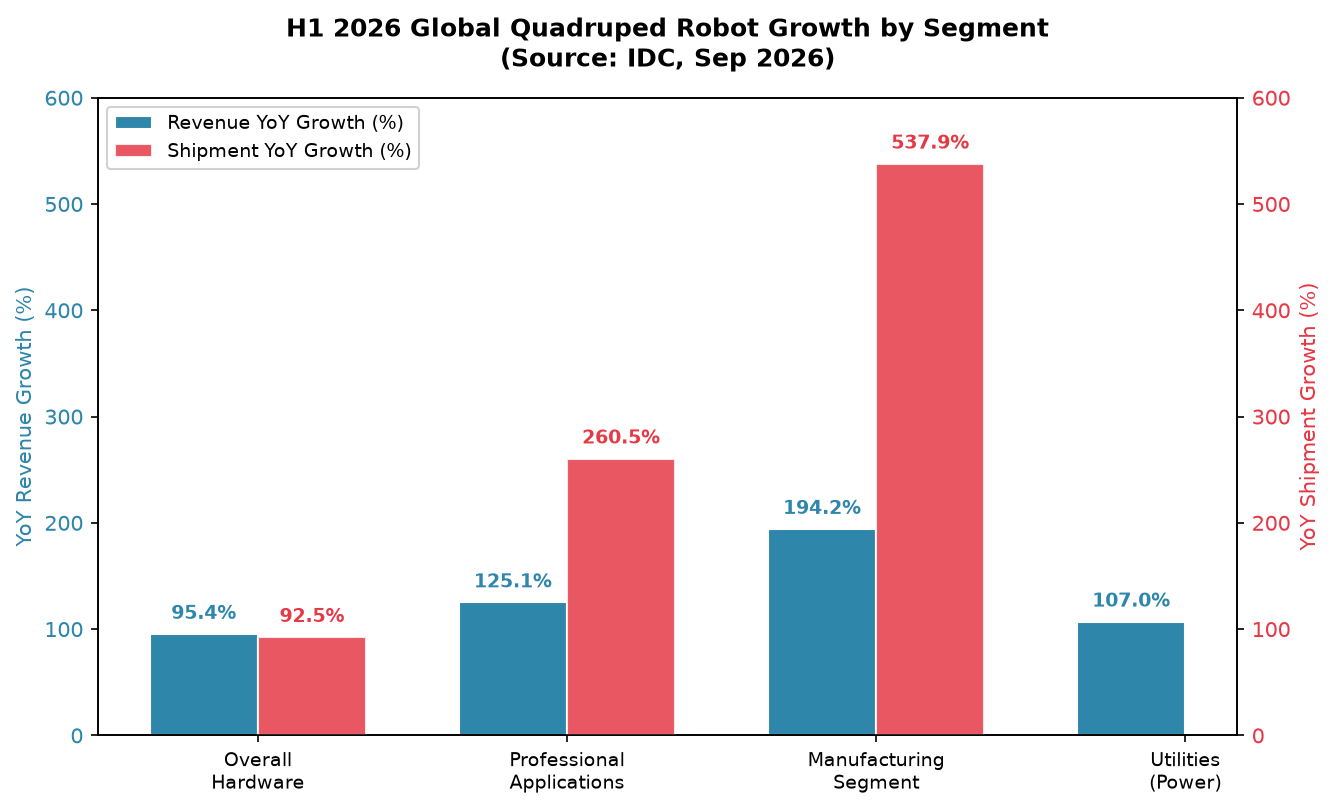
Let us cut straight to the figures that frame every conversation about this sector. According to IDC data published in September 2026, global quadruped robot shipments in the first half of 2026 reached approximately 49,000 units, generating over USD 400 million in hardware revenue — a year-on-year increase of 92.5% in shipments and 95.4% in revenue. That means the first half of 2026 alone already exceeded the entirety of 2025's shipments.
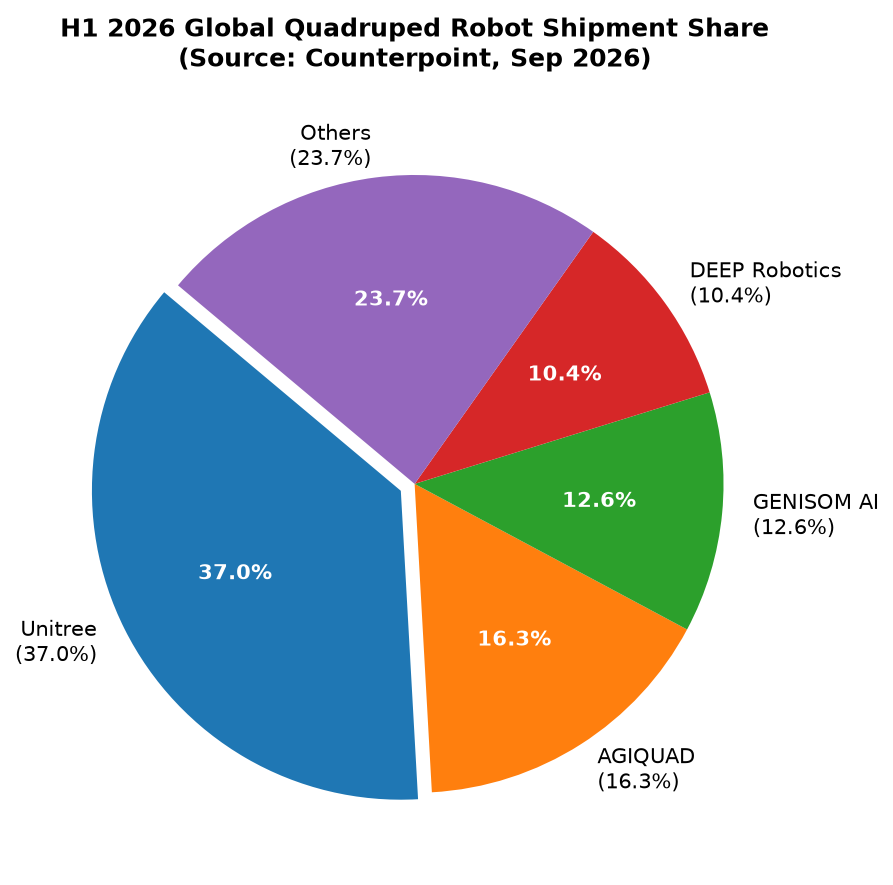
Counterpoint's H1 2026 shipment ranking confirms China's overwhelming dominance. Four Chinese companies together hold roughly 76% of the global market; adding other smaller Chinese vendors pushes the domestic share above 90%.
It is worth noting that the revenue picture looks different from the shipment picture. Consumer and education models — Unitree's Go2, for example, which starts around RMB 9,000 (≈USD 1,250) — account for roughly 60% of units but less than a third of revenue. Industrial units, priced anywhere from RMB 100,000 to over RMB 400,000 depending on sensor loadout and certification, punch far above their weight in dollar terms.
3. Who's Who: Four Chinese Leaders, Four Different Playbooks
Not all Chinese robot dogs are the same product, and not all Chinese robot-dog companies are the same business. The four market leaders have each chosen a distinct wedge into the market. Understanding those wedges is the first step to picking a partner.
HQ: Hangzhou · Founded: 2016 · Listed: STAR Market, Aug 2026 (688836)
- H1 2026 global shipment share: 37%
- 2025 revenue: RMB 1.699B (~USD 236M); gross margin 60.13%
- ~70%+ of quad revenue from consumer/education; industrial B2/B-series growing fast
HQ: Shanghai · Spun out: Aug 2025 (from AGIBOT/智元)
- H1 2026 global shipment share: 16.3%
- #1 worldwide in industrial-application shipments (27.8% of that subsegment)
- ~40% of shipments go overseas; full product matrix (D1 Pro → D1 Ultra)
HQ: Beijing · Founded: Dec 2023 (ex-Xiaomi CyberDog team + Huawei/DJI alumni)
- H1 2026 global shipment share: 12.6%
- "Tongchui" heavy-payload line shipped >1,000 units in H1 for power/fire/explosion-proof use
- Cumulative production surpassed 15,000 units by mid-2026
HQ: Hangzhou · Founded: 2017 · IPO filed: STAR Market, May 2026
- H1 2026 global shipment share: 10.4%; #2 in industrial shipments (26.0%)
- 2025 revenue: RMB 337M (~USD 47M); 79% from industrial applications
- 600+ enterprise clients in 50+ countries; first fully autonomous substation inspection with State Grid
Other notable names include Micro Robotech (具微科技), which IDC ranks #1 in the global manufacturing segment for H1 2026 with strong explosion-proof credentials; Dobot (越疆), whose Rover X1 is carving out a consumer niche as a "jogging companion" at RMB 7,499; Xiaomi (CyberDog); Weilan (蔚蓝) with the BabyAlpha home companion line; and Magic Lab (魔法原子), which gained visibility on the 2026 Spring Festival Gala. There are now more than 50 Chinese companies developing quadruped robots, but the top four already control the majority of revenue and shipments.
4. Unitree Robotics: The Scale King Goes Public
Any conversation about Chinese quadruped robots has to start with Unitree. Founder Wang Xingxing bootstrapped the company in 2016 with a RMB 2 million angel round and built the business around a simple, powerful idea: drive costs down through full-stack self-manufacturing of core components (motors, reducers, drivers, control boards), and sell both to developers and to consumers at prices competitors could not match.
The strategy worked. Revenue grew from RMB 159 million in 2023 to RMB 1.699 billion in 2025 — a compound annual growth rate of roughly 227%. Gross margin in 2025 was 60.13%, an extraordinary number for a hardware company, enabled by a >90% in-house rate on key components and aggressive economies of scale. Average selling price for a Unitree quadruped actually fell from RMB 38,300 in 2023 to RMB 30,300 in 2025, yet margin expanded because production costs dropped faster than prices.
In August 2026, Unitree listed on the Shanghai STAR Market (ticker 688836) in a closely watched IPO that briefly valued the company above RMB 440 billion on debut. The stock has been volatile since — reflecting, in part, investor debate about how much of its revenue still comes from universities and research labs versus true industrial and commercial deployments. As of Q1–Q3 2025, about 73.6% of humanoid revenue came from research/education customers, and quad revenue shows a similar skew.
| Metric | 2023 | 2024 | 2025 | H1 2026 |
|---|---|---|---|---|
| Total revenue (RMB) | 159M | — | 1.699B | 1.15B (+48.5% YoY) |
| Gross margin | — | — | 60.13% | — |
| Quadruped revenue (RMB) | — | ~230M | 698M | — |
| Humanoid revenue (RMB) | — | ~108M | 868M | — |
| Humanoid units shipped | — | — | 5,500+ (#1 globally) | ~5,900–7,000 |
For global partners, Unitree is the obvious starting point if you want volume, brand recognition, a mature developer ecosystem (ROS-compatible, well-documented APIs), and broadest SKU coverage from sub-USD-1,600 consumer models up to industrial B2 units capable of 6 m/s runs and IP67-level environment tolerance.
5. DEEP Robotics: The Industrial Specialist Files for IPO
If Unitree is the company that put Chinese robot dogs in living rooms and university labs, DEEP Robotics (杭州云深处科技) is the company that put them to work. Founded in 2017 by Zhu Qiuguo and a team of Zhejiang University legged-robotics researchers, DEEP made a deliberate decision to focus almost exclusively on industrial and public-sector use cases.
The financials tell the story. In 2025, DEEP reported revenue of RMB 337 million (≈USD 47 million) with a net profit of RMB 28.68 million — its first profitable year. Some 79.3% of that revenue came from industry applications: power grid inspection, firefighting and emergency response, petrochemical plant patrol, underground utility tunnel inspection, and public safety. The Jueying X-series is its industrial workhorse; the lighter Jueying Lite targets research and commercial services; and the Lynx M-series adds a wheel-leg hybrid design for faster traversal on mixed terrain.
DEEP claims several genuine world-firsts: the first fully autonomous quadruped inspection of a State Grid substation, and the first complete quadruped-based emergency firefighting solution. Its customers include over 600 enterprise and government accounts across more than 50 countries.
DEEP filed for its STAR Market IPO in May 2026, aiming to raise RMB 2.5 billion. The prospectus shows that its Jueying X average selling price dropped from RMB 287,500 in 2024 to RMB 228,200 in H1 2026, and gross margin on that line fell from 54.4% to 39.8% — a reminder that even the industrial leader is under price pressure. H1 2026 saw a small net loss of RMB 8.8 million as R&D spending surged 120% and the company ramped headcount ahead of the IPO. Government subsidies accounted for about 41% of 2025 net profit.
6. The Industrial Surge: Where the Real Growth Is
The single most important shift in 2026 is that professional applications are now the fastest-growing segment by far — and they are where most of the revenue lives.
Some numbers deserve a closer look:
- Professional applications overall shipped 19,000+ units in H1 2026, up 260.5% YoY, generating over USD 270 million in hardware revenue (up 125.1%). This category — which bundles industrial inspection, public safety, firefighting, logistics, and energy/utilities — now accounts for roughly two-thirds of global hardware revenue despite representing only about 40% of units.
- Manufacturing was the standout vertical, with H1 revenue of about USD 76.75 million (+194.2% YoY) and shipments up 537.9%. The main use case is autonomous inspection of equipment status and anomaly detection in places where human rounds are dangerous, repetitive, or hard to staff — think high-temperature electrolysis cells, chemical plants with explosion-risk zones, or automotive weld shops.
- Utilities and power generated roughly USD 42.36 million (+107% YoY), driven by substation and converter-station deployments at State Grid and China Southern Power Grid, with increasing traction in cable-tunnel inspection.
A key detail: when a factory or a power utility buys a robot dog, they are almost never buying just the dog. The total project cost includes sensor payloads (visible-light cameras, thermal IR, acoustic sensors, gas detectors), integration with the plant's existing SCADA or asset-management software, on-site commissioning, training, and a multi-year service contract. IDC and Sullivan analysts both note that a fully-deployed industrial project can cost 3–5× the sticker price of the robot itself — which is why industrial players like DEEP and Micro Robotech, despite smaller unit volumes, can produce meaningful revenue and sticky customer relationships.
7. Where the Machines Are Actually Working
Walk past a booth at any of the major Chinese robotics shows in 2026 — WAIC in Shanghai, World Robot Conference in Beijing, IAS in Shenzhen — and you will see the same handful of deployments being demoed, because they are the ones with real budgets behind them:
- Electrical substations: Routine inspection of transformers, switchgear, and thermal hotspots. DEEP Robotics and AGIQUAD are the leading vendors here; deployments can run fully autonomously for months at a time.
- Petrochemical & chemical plants: Explosion-proof patrols in EX Zones 1 and 2. Micro Robotech is the name most often cited for ATEX/IECEx-style certification work in China, and is used by Sinopec and CNPC subsidiaries.
- Firefighting & emergency response: Dogs carry thermal cameras and gas sensors into smoke-filled structures. DEEP's emergency-firefighting solution is the most complete, but multiple vendors now field these units.
- Manufacturing shop floors: General-purpose patrol and equipment monitoring, especially in aluminum smelters, steel mills, and automotive plants where heat, magnetism, or fumes make human rounds unattractive.
- Mining & tunneling: Pre- and post-blast inspection, conveyor monitoring, and underground rescue support.
- Research & education: Still the single largest unit-volume segment. Universities worldwide buy Unitree Go2/A2 and DEEP Jueying Lite units as affordable legged-robotics research platforms.
- Consumer & entertainment: Companion bots (Weilan BabyAlpha, Dobot Rover X1 as a jogging companion), performance bots (Spring Festival Gala), and high-end toys. Fast-growing but low-ASP.
8. The Hard Reality: Bottlenecks Nobody Likes to Discuss
For all the impressive growth numbers, anyone doing serious business in this market should go in with eyes open. Three structural problems keep popping up in conversations with integrators and buyers:
Every industrial site is different. A substation in mountainous Guizhou has different stairs, different Wi-Fi, and different weather than one on the outskirts of Shanghai. That means each deployment still requires a meaningful amount of custom integration, which caps how fast vendors can scale and erodes margins as price competition intensifies. There is no industry-wide standard yet for payload interfaces, charging docks, or fleet-management APIs.
Unitree's 60% gross margin is an outlier, driven by scale and consumer mix. DEEP Robotics only turned its first full-year profit in 2025, and that profit included RMB 11.9 million in government subsidies (about 41% of net). AGIQUAD is essentially a 12-month-old spin-off. GENISOM is just over two years old. For many players in the top 10, the gap between "impressive top-line growth" and "sustainable free cash flow" remains wide.
A robot dog that can do a backflip is not the same as a robot dog that consistently finds a loose bolt on the 3 a.m. round. The industry's current competitive focus — driven-legged locomotion, dynamic balancing, speed records — is increasingly table stakes. What industrial buyers actually pay for is reliability (mean time between failures), uptime, sensor accuracy, autonomous navigation in changing environments, and integrators who can tie the dog into existing workflows. Those capabilities are harder to demonstrate in a 60-second demo reel.
There is also a deeper strategic shift underway: as humanoid robots move from research into early commercial pilots (Unitree's humanoid revenue surpassed quadruped revenue for the first time in 2025), every quadruped vendor is having to decide whether to double down on quadrupeds or invest heavily in bipeds — a decision with major implications for R&D budgets, headcount, and partnership strategy.
9. Beyond the Press Release: Vetting a Chinese Robot Maker
For overseas buyers, distributors, and investors, the core problem is rarely "Is there a Chinese company that makes what I need?" — it is "Which of the 50+ Chinese companies making robot dogs is the real thing?" Headlines do not always match reality. Claimed shipment figures, client logos, patent counts, and certifications are easy to put on a website and hard to verify from 8,000 kilometers away.
Before signing any distribution agreement, placing a volume order, or taking an equity position, experienced operators in this space will typically:
- Pull the company's official registration record from China's National Enterprise Credit Information Publicity System (国家企业信用信息公示系统) to confirm registered capital, legal representative, founding date, registered address, and any administrative penalties. This is the ground truth against which every marketing claim should be checked.
- Cross-check declared revenue and shipment volumes against filed annual reports (年报). For pre-IPO companies, this means triangulating against tax filings disclosed in official records; for newly public companies like Unitree and companies in IPO filing like DEEP Robotics, audited prospectus data is publicly available.
- Examine the management team's background and related-party network using a director/officer investment and appointment report (董监高投资任职及风险报告). In a tightly networked industry like Hangzhou robotics, understanding who is connected to whom — and which other companies a founder controls or invests in — is essential context.
- Verify IP claims by searching the China National Intellectual Property Administration database directly for invention patents (not just utility models or design patents). Many companies cite large aggregate patent numbers that include low-value filings.
- Validate claimed overseas reference customers — a logo on a slide does not mean an active, paid deployment.
Doing this kind of verification from outside China is not trivial. The National Enterprise Credit Information Publicity System requires Chinese-language navigation, Chinese phone verification for certain queries, and familiarity with how Chinese business registration records are structured. That is exactly why professional cross-border due diligence exists: a properly sourced official enterprise credit report will tell you in plain English what a Chinese robot company actually is, rather than what it says it is.
10. Looking Ahead
The next 24 months will be decisive. Industry forecasters (Sullivan, Counterpoint, IDC) converge on a view that 2026 full-year shipments will roughly double 2025's figure to exceed 90,000 units, with total industry revenue approaching USD 15 billion. By 2030, projections consistently put the addressable market above USD 100 billion, driven by sustained 60%+ CAGR as industrial deployments move from pilot to programmatic rollout and as consumer and service robots gradually find repeat-purchase use cases.
Watch three things in particular as you evaluate partners over the coming year:
- Margin trajectory. If a company's gross margin is falling even while revenue scales, it tells you something about pricing power and customer concentration — DEEP's X-series margin compression is a useful early warning sign for the sector.
- Non-research revenue share. The more revenue that comes from real industrial and commercial deployments (as opposed to university labs and government demo projects), the more durable the franchise is likely to be.
- Standards and ecosystem play. Companies that publish open APIs, support common payload interfaces, and build a real integrator network will scale faster internationally than companies that only sell finished boxes.
Chinese quadruped robot companies have, in less than a decade, gone from copycat status to global leadership. That achievement is real. But leadership in shipment volume is the beginning of the story, not the end. The companies that will matter to international partners five years from now are the ones that can combine genuine manufacturing scale with real industrial deployment capability, transparent financials, and the willingness to build the kind of documentation, certification, and support infrastructure that global buyers actually need.
Choosing between them is a business decision, not a beauty contest — and like any cross-border business decision, it starts with knowing who you are really dealing with.
Vetting a Chinese robotics partner? Before placing a purchase order, signing a distribution agreement, or wiring a deposit, verify the company through official Chinese government records — not just their own sales deck. ChinaBizInsight retrieves independent, English-language enterprise credit reports from China's national business registry, screens directors and shareholders for hidden risks and connected companies, and handles notarisation and apostille of Chinese documents for use overseas. Talk to us before you commit.
References & Further Reading
- IDC, Worldwide Commercial Quadruped Robot Tracker, H1 2026, published September 2026.
- Counterpoint Research, Global Quadruped Robot Market Share Report, H1 2026, September 2026.
- Frost & Sullivan (沙利文), Global Quadruped Robot Industry White Paper, 2026 edition.
- Unitree Robotics Co., Ltd. (宇树科技), IPO Prospectus and 2026 Interim Report, Shanghai Stock Exchange STAR Market (stock code 688836).
- DEEP Robotics Co., Ltd. (杭州云深处科技), IPO Prospectus and First-Round Inquiry Reply, Shanghai Stock Exchange STAR Market, May–August 2026.
- Hangzhou Municipal Government, "Chinese robot maker Unitree to debut on Shanghai market", ehangzhou.gov.cn, August 18, 2026.
- National Business Daily (每日经济新闻), "Unitree Dominates Global Quadruped Robot Market with 37% Share", September 22, 2026.
- Changjiang Business Daily (长江商报), coverage of DEEP Robotics IPO filing and financial disclosures, August–September 2026.
- Ministry of Industry and Information Technology of China (MIIT), H1 2026 robotics industry statistics.
ChinaBizInsight
Your strategic bridge to transparent business in China.