
Inside China’s Quadruped Robot Supply Chain: Key Players, Component Verification, and Quality Assurance
When an overseas integrator or buyer looks at a Chinese robot dog priced at one-third to one-fifth of a Western equivalent, the first question is rarely “does it work?” — it is “how is it built, who built the parts inside it, and will those parts still be in production twelve months from now?” This guide dissects China’s quadruped robot supply chain layer by layer: which components are genuinely localised, where the bottlenecks still sit, how the biggest players (Unitree, Qiteng, DEEP Robotics, Laifual, Meihu) are reshaping the supplier map, and — most critically — how an overseas buyer can independently verify whether a Chinese component supplier actually has the registered capital, manufacturing scope, patents, and clean compliance record they claim on their website.
- The Two-Tier Supply Architecture Behind China’s Robot Dog Boom
- Where the Money Goes: BOM Cost Breakdown
- Localisation Scoreboard: What Is Made in China — and What Is Not
- The 943-Million-Yuan Deal That Signalled Maturity
- Vertical Integration vs. Open Supply: Two Business Models
- Component-by-Component Due Diligence Framework
- How to Verify a Chinese Component Supplier Independently
- Key Supply-Chain Risks and Red Flags
1. The Two-Tier Supply Architecture Behind China’s Robot Dog Boom
China shipped roughly 44,000 of the ~49,000 quadruped robots sold worldwide in the first half of 2026. That 90%-plus share is not accidental. It is the visible output of a supply architecture that has been quietly built over the past decade and now exists nowhere else on earth. Industry analysts describe it as a two-tier structure:
This layered structure is what gives Chinese robot makers both speed and cost leverage. When Unitree wants to iterate a new motor winding, a factory in Jiangsu can produce a prototype batch in days; when Qiteng needs 180,000 actuators for a 20-month product cycle, a supplier cluster already exists that can, in principle, scale up. But the same density that delivers speed also creates risk for foreign buyers: the line between a legitimate component factory with real production lines and a trading company with a polished website and a WeChat alias is often invisible from overseas.
2. Where the Money Goes: BOM Cost Breakdown
For anyone sourcing robot dogs or robot-dog components from China, the first number that matters is this: joint modules (actuators) are the single largest cost item by a wide margin. According to the EO Intelligence China Quadruped Robot Commercialisation Research Report and cross-checked against SemiAnalysis’ teardown of the Unitree G1, the bill of materials looks like this:
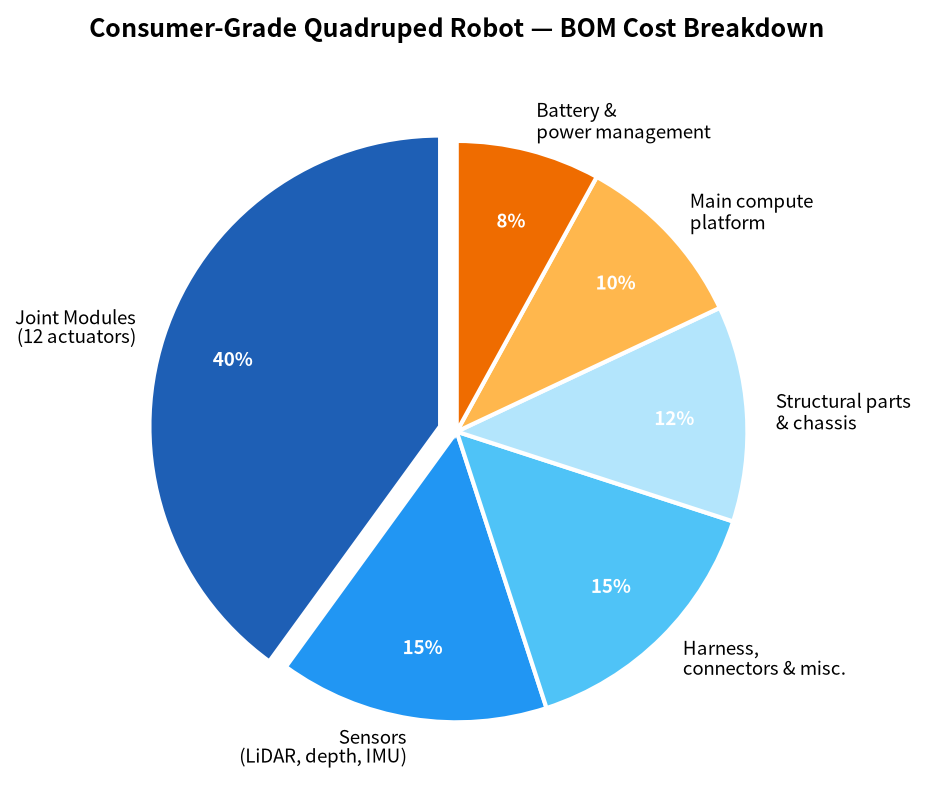
| Cost module | Consumer-grade | Industrial-grade | Why it matters for buyers |
|---|---|---|---|
| Joint modules (12 actuators) | ~40% | 30–45% | Motor + gearbox + encoder + driver; determines torque, reliability and price. This is the #1 lever for negotiation. |
| Perception & compute (LiDAR, depth cam, AI SoC) | ~15% | 10–20% | Industrial and specialty bots add multi-mode radar and edge GPU; consumer bots use cheaper solid-state LiDAR. |
| Software & algorithms | bundled | 8–18% | Industrial SLAM, inspection AI stacks and MPC/WBC control are sold separately or bundled into service fees. |
| Battery & BMS | ~8% | 4–10% | Mostly Chinese cells; consumer 1–2h runtime vs industrial 3–5h. |
| Structural parts & chassis | ~12% | 5–12% | Aluminium / magnesium / carbon-fibre casting; IP67 variants carry a premium. |
| Operations & maintenance | negligible | 8–15% | Deployment cycle compressed from 7–20 days (2025) to 3–9 days (2026); annual O&M ≈ 5–8% of unit price. |
The takeaway for procurement teams is blunt: negotiating the actuator price moves the needle more than any other line item. A 10% reduction in joint-module cost translates directly into a 3–4.5% reduction in total BOM for a consumer unit. That is why the actuator supply chain is where the fiercest battles in China’s robot-dog industry are being fought right now.
3. Localisation Scoreboard: What Is Made in China — and What Is Not
One of the most persistent myths in Western robotics coverage is that “China imports all the core parts and only does final assembly.” That was true in 2015. It is not true in 2026. Official MIIT figures and the EO Intelligence report converge on an overall core-component localisation rate of more than 75% for quadruped robots, but that headline hides very uneven progress across sub-components.
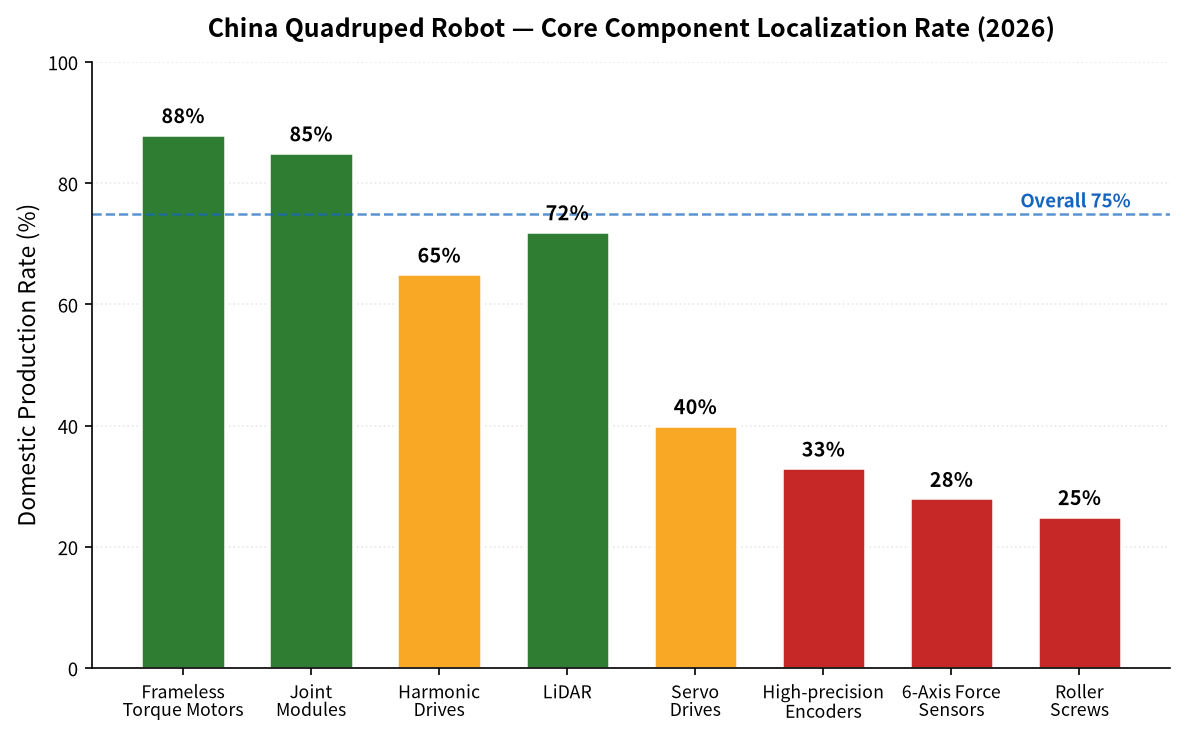
The picture in numbers: frameless torque motors and complete joint modules are overwhelmingly sourced domestically, with domestic pricing typically running at 50–70% of the import equivalent. Harmonic drives are at 60–70% localisation, led by Leaderdrive (Laifual, 来福谐波) and Leader Harmonic (绿的谐波), which together form a de-facto duopoly for humanoid- and quadruped-specific harmonic reducers. LiDAR has crossed 70% domestic penetration thanks to Hesai, RoboSense and Unitree’s in-house L-series.
The bottlenecks are concentrated at the high end. Servo drives are only 35–45% localised, with high-bandwidth EtherCAT drives still sourced from Japanese and German vendors for precision industrial applications. High-precision encoders (especially 23-bit+ absolute units with BiSS-C or EnDat 2.2 protocol) remain below 35% domestic penetration. Planetary roller screws, used in next-generation linear actuators for humanoids and some industrial quadrupeds, are 20–30% domestic. Automotive-grade AI compute chips are still largely imported from Nvidia; domestic alternatives (Horizon Robotics, Cambricon, Black Sesame) are at roughly 40% penetration on the BOM and climbing fast — EO Intelligence projects 70% by 2029.
4. The 943-Million-Yuan Deal That Signalled Maturity
If there was a single moment when the world outside China woke up to the scale of the domestic quadruped supply chain, it was 9 May 2026.
On that date, Meihu Co., Ltd. (美湖股份, SSE: 603319) — a Hunan-based auto-parts manufacturer that has pivoted into robot actuators — announced a CNY 943.182 million (~USD 130 million) annual procurement framework with Qiteng Robotics (七腾机器人), one of China’s leading specialty quadruped makers best known for its explosion-proof inspection bots used in petrochemical plants. The contract, running from 25 April 2026 to 31 December 2027, covers actuators including planetary gearboxes, harmonic reducers, motors and drivers, plus structural castings — the core guts of a robot dog.
What the Qiteng–Meihu deal really tells international buyers
The good: At ~USD 130 million, it is the largest single quadruped-component order ever signed in China. It confirms that specialty robot makers (not just consumer brands like Unitree) are now placing volume orders that rival automotive-tier contracts, and that traditional auto-parts companies are converting lines over to robot production — a sign of genuine industrial capacity, not pilot-line hype.
The catch (every buyer should read this): The deal triggered a same-day regulatory inquiry letter from the Shanghai Stock Exchange. Meihu disclosed that (1) the 943 million yuan figure is an estimated maximum ceiling — actual purchase orders will be placed in batches and are not binding; (2) Meihu’s current actuator capacity is 100,000 units per year, while the contract would require ~180,000 units; (3) Meihu is simultaneously raising CNY 980 million in a private placement, CNY 300 million of which is earmarked for new actuator capacity that will take 36 months to build; (4) Meihu’s Q1 2026 net profit fell 59.25% year-over-year. The stock initially hit the daily limit up, then fell ~20% over three trading days.
The lesson: A large framework contract announced on a supplier’s WeChat account is not the same thing as a funded, capacity-backed order. International buyers who see suppliers quoting “943 million yuan partnership with Qiteng” as a credibility credential need to look past the press release.
5. Vertical Integration vs. Open Supply: Two Business Models
Within this two-tier architecture, Chinese quadruped makers have split into two distinct camps. Understanding which camp a potential partner sits in tells you a great deal about their unit economics, their supplier dependencies, and the risk profile of sourcing from them.
For an overseas buyer, the implication is direct: a Camp A OEM is essentially selling you its own engineering (and guarding its supply chain closely); a Camp B OEM is a systems integrator, and its real capability is in application engineering and certification, not in component manufacturing. When evaluating a Camp B supplier, component-level diligence is not optional — because many of the parts inside their robots come from third parties whose names may never appear on the spec sheet.
6. Component-by-Component Due Diligence Framework
Below is a practical, component-by-component checklist for any international procurement team sourcing quadruped robots or quadruped components from China. For each module, we list what to ask for, what to verify independently, and which public-record or data sources can be checked from outside China.
| Component | What the brochure says | What to verify independently | Key risk |
|---|---|---|---|
| Joint modules / actuators | “Self-developed, 12 N·m continuous, 35 N·m peak” | Check manufacturer’s registered business scope includes motor/reducer manufacturing; look for patents on motor winding, gear profile; cross-reference paid-in capital against claimed annual capacity (a CNY 5 m registered company cannot deliver 100k actuators/year) | Trading companies rebranding generic modules; capacity claims vs. actual factory floor |
| Harmonic / planetary gearboxes | “Harmonic drive, zero backlash, 10,000 h life” | Check whether it is a genuine Laifual / Leaderdrive / HD / Sumitomo unit, or a reverse-engineered copy. Ask for the supplier’s purchase invoices or authorisation letter. Verify reducer manufacturer’s ISO and quality certifications via CNCA (Certification and Accreditation Administration). | Copycat reducers with 30–50% shorter life; IP infringement risk for re-exporters |
| Encoders | “17-bit / 23-bit absolute encoder” | High-precision absolute encoders are still largely imported (Tamagawa, Heidenhain, Renishaw). If a vendor claims “self-developed 23-bit absolute encoder,” cross-check patent filings and verify against paid-in capital and R&D staff counts in official filings. | Misrepresented encoder resolution — a 17-bit unit labelled as 23-bit will cause positioning errors in industrial inspection |
| LiDAR / depth cameras | “360° LiDAR, 20 m range, industrial-grade” | Identify the actual LiDAR model and verify the manufacturer’s IP rating (industrial bots need IP65+); many cheap “industrial” units reuse consumer-grade Hesai / RoboSense / Unitree L1 modules. | Consumer sensors deployed in industrial / outdoor environments fail within months |
| Battery & BMS | “High-density lithium, 2–4 h runtime” | Check cell maker (CATL, BYD, EVE, Gotion are credible; unknown cells are a fire risk for sea freight and a customs red flag). Verify UN38.3, IEC 62133, CE, FCC certification. | Uncertified batteries cause shipping refusals and fire liability; runtime claims inflated in spec sheets |
| AI compute / controller | “Edge AI, autonomous navigation” | If Nvidia Orin / Jetson is claimed, verify supply chain authorisation (export-control risk). Domestic chips (Horizon, Cambricon) require SDK and long-term software support commitments. | US export controls on high-end Nvidia SoCs; “orphaned” domestic chips with no future SDK updates |
| Structural parts / castings | “Aerospace-grade aluminium, IP67” | Verify IP rating certificates, salt-spray test reports (for outdoor/coastal deployments). Check business scope for casting / machining activities. | IP rating claimed on paper but not achieved in assembly; magnesium parts corroding in coastal deployments |
7. How to Verify a Chinese Component Supplier Independently
The single biggest mistake international buyers make is to take a Chinese supplier’s own website and sales deck as the primary source of truth. The good news is that, since 2014, every registered company in mainland China is required to file a significant amount of information with the State Administration for Market Regulation (SAMR), and this information is publicly retrievable — but only in Chinese, only via identity-verified accounts, and in a format that is difficult for non-Chinese speakers to navigate.
Here is what a proper supplier-verification workflow looks like in practice.
✅ Five-Step Supplier Verification Checklist
- Pull the official enterprise credit report from the National Enterprise Credit Information Publicity System (NECIPS / 国家企业信用信息公示系统). This confirms: legal existence, unified social credit code, legal representative, registered address, registered vs. paid-in capital, business scope (does it actually include “motor manufacturing” or “reducing gear manufacturing”, or just “wholesale of electronic products”?), any administrative penalties, and any operating-abnormal listings. If the business scope does not list the component being sold, you are almost certainly dealing with a trading company, not a manufacturer.
- Cross-check annual reports. Chinese companies file annual public reports (工商年报) with SAMR that list turnover ranges, employee counts, social-insurance headcount and major shareholders. A supplier claiming to “produce 100,000 actuators per year” but showing only 12 employees on social insurance is not a factory. Social-insurance headcount is one of the hardest numbers to fake.
- Run a patent and IP check. Search the China National Intellectual Property Administration (CNIPA) database for invention patents (发明), utility-model patents (实用新型) and design patents filed by the company in question. A legitimate motor or gearbox maker will typically hold dozens of invention patents; a trading company will hold zero or a handful of trivial utility models. Pay particular attention to who the inventors are and whether they match the claimed technical team.
- Screen the directors, supervisors and senior management (董监高). An executive background check reveals whether the company’s key people have prior experience in robotics, precision manufacturing or related fields — or whether they come from entirely unrelated industries (a common red flag for shell companies pivoted into the “robotics boom” for investment optics). It also uncovers connected companies: a supplier that appears independent on paper may actually be a sister company of the OEM, with all the related-party-pricing risks that implies.
- Check litigation, enforcement and environmental records. Run the company name through the China Judgements Online (裁判文书网) and China Enforcement Information Publicity (中国执行信息公开网) databases. Contract disputes with previous buyers, unpaid supplier debts, labour disputes and environmental penalties are all matters of public record — and all have direct implications for delivery reliability.
For overseas teams that do not have a Chinese-registered legal entity or a Chinese-speaking compliance team on staff, steps 1 and 2 can be done efficiently by ordering an official enterprise credit report through an authorised retrieval service — delivered in English, directly sourced from the SAMR registry, and typically available within a few working days. Steps 3–5 usually require a professional credit report or an executive risk report, which layers in patent searches, litigation screening and management background checks on top of the registry data.
Why is all of this especially important in the robot-component space? Because in 2026, capital is flooding into precisely these upstream parts: according to industry tallies, there were 322 financing events in China’s robotics sector in the first half of 2026 alone, with the majority of the money flowing into core-component startups rather than end-product OEMs. A hot money environment is great for dynamism, but it also creates a long tail of companies with polished websites, recent seed funding, and no real production capacity — exactly the kind of counterparty an overseas buyer wants to screen out before wiring a deposit.
8. Key Supply-Chain Risks and Red Flags
Even after a supplier passes the basic registration and patent checks, there are structural risks specific to the Chinese quadruped robot supply chain that deserve special attention.
⚠️ Seven Supply-Chain Red Flags for International Buyers
- “Framework contract” press releases without binding purchase orders. As the Qiteng–Meihu case showed, large announced deals are often aspirational ceilings, not committed volumes. Ask for signed, stamped purchase orders and payment evidence, not just press clippings.
- Paid-in capital far below registered capital. A company showing RMB 50 million registered but only RMB 1 million paid-in is still effectively a small business; treat production-capacity claims accordingly.
- Business scope limited to trading / wholesale / import-export when the product is advertised as “self-manufactured.” This is the single most reliable indicator of a trading company masquerading as a factory.
- Social-insurance headcount under 20 for a claimed “actuator manufacturer.” Real actuator production lines (machining, winding, assembly, testing) require dozens of staff.
- No invention patents, only utility models. Utility-model patents are granted without substantive examination in China and are a weak signal of R&D capability; a genuine precision-mechanics maker will hold invention patents.
- Key suppliers named in brochures that have never heard of your counterparty. Always reverse-reference by asking the named upstream (e.g. Laifual, Hesai, Nvidia) whether they actually supply the company — component OEMs generally have public distributor lists.
- Export-control exposure. Quadruped robots with certain payload capacities or autonomous-navigation capabilities may fall under dual-use export controls, both from China and from the end-market country. Verify ECCN classification, China’s dual-use export-licence requirements, and any end-use declarations before finalising a purchase.
Looking ahead: what will move next in the supply chain
Three forces will reshape the supply chain over the next 24–36 months:
- Axial-flux motors. Next-generation axial-flux (pancake) actuators are expected to cut joint-module cost by a further 20–30% while boosting torque density, accelerating the price decline that has already brought consumer-grade quadrupeds within striking distance of the CNY 5,000–8,000 (~USD 700–1,100) “mass-adoption threshold.”
- Scale economics from humanoid production. Unitree’s 2026 humanoid output is projected in the tens of thousands of units, and every G1/H1/R1 produced uses the same family of actuators as its four-legged siblings. Shared components across form factors will continue to amortise R&D and drive down per-unit actuator cost.
- Encoders and high-end force sensors as the next localisation frontiers. These are the components where Japanese and German incumbents still hold pricing power; the first Chinese vendor to ship a reliable, mass-produced 23-bit absolute encoder at half the import price will capture enormous leverage across the entire Chinese robot industry.
Sourcing robot components from China? Verify before you wire.
Before placing a purchase order, signing a distribution agreement, or paying a tooling deposit for quadruped robot components, confirm the supplier’s registered identity, paid-in capital, business scope, patents, litigation history and management background through official Chinese government records — not just the supplier’s own website. ChinaBizInsight retrieves independent, English-language enterprise credit reports and executive risk reports directly from China’s national registries, and handles patent and IP verification, document notarisation and Hague apostille for cross-border procurement teams. Talk to us before you commit →
References
- EO Intelligence (亿欧智库), China Quadruped Robot Commercialisation Research Report, September 2026.
- SemiAnalysis, “China’s Unitree Will Dominate Global Robotics” — G1 teardown and cost analysis, 9 June 2026.
- Meihu Co., Ltd. (美湖股份, SSE: 603319), Announcement of Annual Procurement Contract with Qiteng Robotics, 11 May 2026; Shanghai Stock Exchange regulatory work letter, same date.
- Ministry of Industry and Information Technology (MIIT), 2026 H1 robot industry operation data; Baidu Baike “Robot Industry Chain” entry, citing MIIT & National Bureau of Statistics, updated 1 October 2026.
- Unitree Robotics (宇树科技, 688836) IPO Prospectus and 2025 Annual Report, Shanghai Stock Exchange STAR Market.
- Laifual Harmonic (来福谐波) Prospectus and capacity disclosures; Zhejiang Shengzhou plant opening announcement, August 2025.
- Donghai Securities Research Institute, Humanoid Robot Joint Drive Cost Structure Note, July 2026.
- China National Enterprise Credit Information Publicity System (NECIPS / 国家企业信用信息公示系统) — public company registry records.
ChinaBizInsight
Your strategic bridge to transparent business in China.