
Chinese Robot Dog Startups: Financial Verification and Risk Assessment for Global Investors
Table of Contents
- The CNY 93.5 Billion Funding Wave — and Why It Masks Risk
- Two IPOs, Two Valuation Logics: Unitree vs. DEEP Robotics
- Six Due-Diligence Red Flags for Chinese Robot Startups
- Beyond the Pitch Deck: What Financial Documents Actually Reveal
- Connected Parties, Customer Concentration, and the Executive Risk Trail
- A Five-Step Investor Verification Workflow
- The Regulatory Window — Why Speed Matters Now
- References
Global capital is pouring into Chinese quadruped-robot and embodied-intelligence companies at a pace not seen since the peak of the consumer-Internet boom. In the first half of 2026 alone, the broader embodied-AI sector in China recorded 322 disclosed funding rounds totalling CNY 93.5 billion — a figure that already dwarfs the full-year 2025 total of CNY 39.8 billion and is roughly five times the H1 2025 figure. Two companies — Unitree Robotics and DEEP Robotics (云深处科技), both members of Hangzhou’s famed “Six Little Dragons” cohort — have already filed for STAR Market listings, with Unitree clearing its listing review in a record-breaking 73 days.
For global investors, this is both an extraordinary opportunity and an unusually treacherous one. Valuations are being set inside a compressed hype cycle, revenue numbers can be heavily inflated by data-collection “robot farms,” government subsidies and related-party sales, and the standard Western due-diligence playbook — reference calls, management interviews, public filings — frequently breaks down when applied to private Chinese technology companies. This guide walks through the financial architecture of the current boom, the specific risk dimensions that matter most for robot-startup investing, and a practical verification workflow that institutional investors can deploy before signing a term sheet or wiring capital.
1. The CNY 93.5 Billion Funding Wave — and Why It Masks Risk
The headline numbers are impossible to ignore. According to IT Juzi data cited by NetEase and Caixin in Q3 2026, China’s embodied-intelligence sector closed 322 deals in H1 2026, raising CNY 93.5 billion in disclosed capital. The average deal size has ballooned: a single month’s ten-billion-yuan mega-round has become routine, and companies barely six months old are closing angel rounds at CNY 100 million and above.
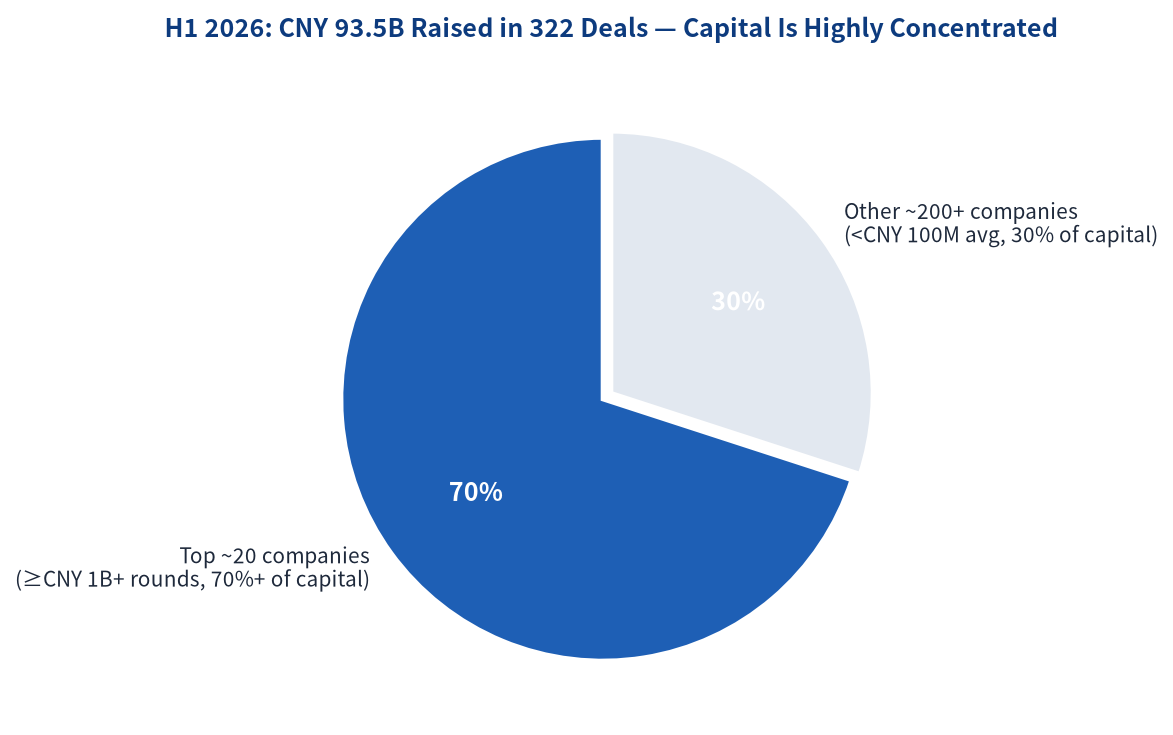
The aggregate numbers, however, hide a sharp bifurcation. Multiple industry analyses (Caixin, Baijiahao/LatePost, 36Kr) converge on the same finding: the top 20 companies captured more than 70% of all capital deployed, leaving the remaining 200+ funded firms to split less than 30%. Average deal size for companies below the head of the curve is measured in tens of millions of yuan, not hundreds of millions. This “barbell” pattern has two direct implications for investors.
First, valuation discipline is breaking down at the early-stage end. Multiple reports in Q3 2026 documented startups founded by ex-auto executives closing second-round term sheets before the company was even registered, and dexterous-hand companies with less than CNY 10 million in 2025 revenue being marked at CNY 20 billion valuations within 20 months. Club deals — where syndicates of top-tier funds agree to lead successive rounds at escalating marks — have become common.
Second, revenue quality has replaced demo quality as the decisive valuation driver. The pitch-deck era, in which a viral back-flip video could close a Series B, is over. Capital is now explicitly rewarding companies with factory and logistics deployments, repeat purchase orders, and verifiable unit economics, while penalising companies that cannot demonstrate paying customers outside the data-collection-centre loop.
Investor takeaway. In a market where early-stage valuations are set partly by syndicate consensus rather than fundamentals, independent verification of revenue, customers and supply chain is not optional — it is the only way to avoid buying into marks that have been manufactured by the very funds selling you the round.
2. Two IPOs, Two Valuation Logics: Unitree vs. DEEP Robotics
The two most consequential public-market events of 2026 — Unitree Robotics’ STAR Market debut on 19 August 2026 and DEEP Robotics’ IPO acceptance on 18 May 2026 — illustrate why headline multiples in this sector cannot be taken at face value. The two companies sit in the same city (Hangzhou), compete in overlapping quadruped-robot categories, and are routinely bracketed together as leaders of the “China robot dog” wave. Yet their financial profiles and valuation logics diverge sharply, and the divergence is exactly what a global investor needs to understand.
Unitree Robotics
- 2025 RevenueCNY 1.708B (+335%)
- 2025 Net Profit (adj.)CNY ~600M
- Gross Margin 202560.1%
- Humanoid shipped 20255,500+ units (#1 globally)
- Quadruped cumulative33,294 units
- Pre-IPO valuation≈ CNY 42B (P/S ~25×)
- Revenue mix73.6% R&D/education · 9% industrial
- Days from acceptance to pass73 (STAR record)
DEEP Robotics (云深处)
- 2025 RevenueCNY 337.5M (+227%)
- 2025 Net ProfitCNY 28.7M (first profitable year)
- Gross Margin 202552.8% (H1 2026: 45.3%)
- Humanoid shipped 20251 unit (4 units across 2 yrs)
- Industrial revenue share79% (power inspection #1 globally)
- Implied IPO valuation≈ CNY 13.9B (P/S ~41×)
- Government subsidies / NP41.5% of 2025 net profit
- H1 2026 net profit–CNY 8.8M (return to loss)
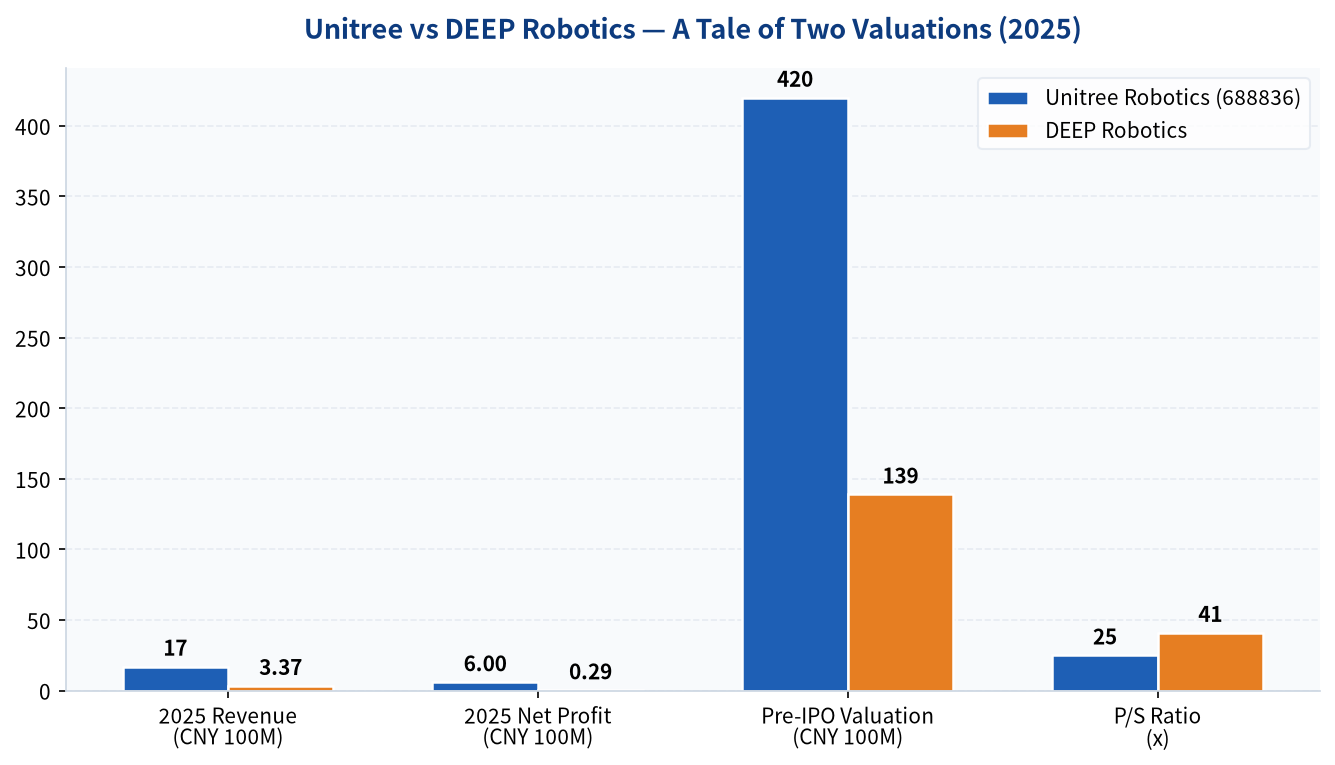
The paradox is hard to miss. Unitree generated five times DEEP’s revenue and more than twenty times its net profit, yet the capital markets priced DEEP at roughly 41× trailing sales versus Unitree’s roughly 25× at the pre-IPO mark — a 60–70% valuation premium per unit of revenue. Why? Because DEEP derived 79% of its revenue from industrial applications (power-grid inspection, emergency response, security patrols) while Unitree’s revenue was heavily weighted toward the consumer/research segment, where 73.6% of 2025 sales went to research and education customers.
Industrial revenue, in the current market narrative, is seen as “stickier,” more recurring, and less vulnerable to the price compression that is already hitting consumer-grade robot dogs. But investors should not take that narrative on faith. Three data points in DEEP’s own prospectus deserve close scrutiny:
- Profit quality. Of DEEP’s CNY 28.7 million 2025 net profit, CNY 11.9 million (41.5%) came from government grants. Stripping those out, recurring net profit was CNY 15.1 million. By H1 2026 the company had returned to a net loss of CNY 8.8 million, and gross margin on its flagship X30 quadruped had fallen from 54.4% to 39.8% due to large-customer bulk procurement discounts.
- Customer concentration. Three of DEEP’s top-five customers in 2025 were other robotics companies buying units for R&D testing, not end users. As one industry executive put it, “any robot company can sell 500 units to 500 competitors who buy one to tear it down.”
- Humanoid gap. DEEP sold four humanoid robots over two years (3 in 2024, 1 in 2025) generating CNY 823,000 in revenue. Unitree sold 5,500+ in 2025 alone. To the extent future valuation is anchored on humanoid potential, this is a material gap.
The lesson is not that one company is a “buy” and the other a “sell.” It is that in this sector, headline revenue tells you very little until you decompose it by customer type, gross margin trajectory, exposure to government subsidies, and exposure to competitor-as-customer circular sales. None of these decompositions can be done from a pitch deck. They require going back to primary registry records, tax filings and public customer lists.
3. Six Due-Diligence Red Flags for Chinese Robot Startups
Based on our work reviewing public filings, litigation records and ownership structures across more than a dozen Chinese quadruped-robot companies, we see six categories of risk that consistently surface and are consistently under-weighted in overseas investor memos.
1. Revenue from “data farms”
A large buyer base in 2025–2026 are data-collection centres that buy hundreds of robots solely to generate embodied-AI training data which they resell to Big Tech. Reuters reports that stripping out data-centre revenue could cut some firms’ valuations by 60–70%.
2. Government-subsidy dependency
Local government subsidies, tax rebates and industrial-park grants can account for 30–50% of reported profit at early-stage robot firms. Verify the share of profit attributable to non-operating income on the income statement.
3. Related-party customers
It is not uncommon for founders, their relatives, or affiliated investment vehicles to control entities that appear as “major customers.” Cross-checking top customers against the founder’s and directors’ other holdings is essential.
4. Patent inflation
Reported patent counts often bundle utility-model patents (cheap, unexamined, low inventive step) with true invention patents. DEEP’s 121 authorised patents, for instance, include only 25 domestic invention patents.
5. Receivables bloat
Rapid revenue growth accompanied by ballooning accounts receivable (especially from SOE or government customers on 180+ day terms) can mask cash-collection problems. Verify VAT invoice data against reported revenue.
6. Supply-chain single points
High-end encoders, certain reducers and specific servo drives are still dominated by Japanese/German suppliers. Companies claiming 100% domestic sourcing need to be verified against their actual procurement invoices.
4. Beyond the Pitch Deck: What Financial Documents Actually Reveal
The standard offshore investor data room for a Chinese robot startup will typically contain a management-prepared P&L, a capitalisation table, and a set of marketing-friendly customer case studies. What it rarely contains, and what matters most for verification, is the set of documents that exist independently of management — filed with Chinese government authorities and therefore not manipulable in the ordinary course.
| Document | Where it lives | What it reveals that the pitch deck won’t |
|---|---|---|
| Official Enterprise Credit Report (国家企业信用信息公示报告) | State Administration for Market Regulation (SAMR) / National Enterprise Credit Information Publicity System | Registered capital vs. paid-in capital, legal representative, registered address, business scope, administrative penalties, operational abnormalities, equity pledges, and a complete history of registration changes. This is the ground-truth document; anything in the pitch deck that contradicts it is wrong. |
| Industrial & Commercial Filings (工商内档) | Local branch of SAMR; not public online, must be retrieved in person | Original articles of association, all historical shareholder agreements, capital verification reports, and identity documents of legal representatives and supervisors. Essential for reconstructing true ownership. |
| Annual Filing Returns (工商年报) | Submitted annually to SAMR; contains self-reported but officially filed financial summary | Revenue bands, total assets, tax payments, social-insurance headcount and (for select entities) simplified balance-sheet data. Discrepancies between filed revenue and pitch-deck revenue are the single fastest fraud detector. |
| Tax & VAT Data (税务/发票数据) | State Taxation Administration; access requires consent or legal authorisation | Actual invoiced revenue by counterparty, VAT payment history, and any outstanding tax liabilities. The cleanest possible cross-check on whether claimed customers actually paid the claimed amounts. |
| Patent & IP Records | China National Intellectual Property Administration (CNIPA) | Breakdown of invention patents vs. utility models vs. designs; legal status (granted, pending, rejected, abandoned); assignee history; patent pledges used as loan collateral. |
| Court & Litigation Records | China Judgements Online, China Enforcement Information Publicity Network | Pending and concluded commercial disputes, labour lawsuits, enforcement actions against the company or its legal representative (including high-consumption restrictions and dishonest-judgement-debtor status). |
The professional enterprise credit report is the document we most often recommend as a starting point for offshore investors because it aggregates the above data sources — SAMR registration, court records, administrative penalties, operational anomalies and key financials — into a single English-language deliverable and flags the most common risk indicators automatically.
A note on paid-in capital. A surprisingly common issue we see is pitch decks quoting “registered capital of CNY 100 million” as proof of financial substance. Under China’s subscribed-capital system, registered capital can be set arbitrarily and is not required to be paid in for up to 30 years. The figure that actually matters is paid-in capital (实缴资本), which reflects real money injected into the company. The gap between the two can be an order of magnitude.
5. Connected Parties, Customer Concentration, and the Executive Risk Trail
Some of the costliest investment mistakes in Chinese hardware companies have come not from misjudging the technology but from misjudging the people. Founders of robot startups are often repeat entrepreneurs with academic positions at leading universities (Zhejiang University, in the case of both Unitree’s Wang Xingxing and DEEP’s Zhu Qiuguo), and they frequently sit on the boards of, or hold equity in, a network of suppliers, distributors and affiliated technology companies. Mapping that network is the job of an executive background and risk report.
Three specific checks should be non-negotiable:
- Director/Supervisor/Senior Management (董监高) cross-holdings. For every named executive, pull the full list of companies in which they serve as legal representative, director, supervisor or shareholder (a 董监高投资任职及风险报告). This is the map that reveals whether a “top five customer” is actually controlled by a family member or former classmate, and whether any upstream “key supplier” is a related party from which margin is being artificially stripped or inflated.
- Equity pledge history. Founders pledging shares to secure personal or corporate loans are a common precursor to liquidity stress. These pledges are recorded with SAMR but rarely disclosed in data rooms.
- Dishonest judgement debtor (失信被执行人) status. If the founder, legal representative or any key subsidiary has been placed on the Supreme People’s Court dishonesty list, it restricts their ability to travel, bid on government contracts, or open new bank accounts — a material event for any company that sells into state-owned utilities.
For financial verification specifically, the financial and tax credit report goes one level deeper than the standard credit report by pulling VAT-invoice data, tax-payment records, and key financial statements, and is the most reliable instrument we know of for cross-checking whether a portfolio company’s internally reported revenue figures reconcile with what was actually declared to the tax authorities.
6. A Five-Step Investor Verification Workflow
For VC/PE firms, banks extending credit to Chinese robot companies, or corporates negotiating strategic investments or JV partnerships, we recommend a structured five-step workflow. It is designed to be completed within 7–10 business days and to be light enough to deploy on every shortlisted target before signing a term sheet.
Pull the official SAMR credit report
Start with the primary-source registration record. Confirm legal name, unified social credit code, legal representative, registered address, business scope, paid-in capital (not just registered capital), shareholders and any recorded administrative penalties or operational abnormalities. Flag anything that diverges from the pitch deck for follow-up.
Cross-check declared revenue against annual filings and tax data
Request (or retrieve independently) the industrial-annual-filing return and tax/VAT summaries. Compare reported revenue bands, headcount counts and tax payments against management’s P&L. For pre-revenue or early-revenue companies, social-insurance headcount is a useful proxy for real operational scale.
Map the executive network and related-party web
Run a director/supervisor/officer holdings report on every founder, director and legal representative. Identify any customer, supplier or distributor in the data room that appears on that list. Cross-check against patent assignments (founders sometimes assign core IP to personally held entities before the funding round).
Audit the IP portfolio for quality, not just quantity
Break the patent list down into invention patents (inventive-step examined, strongest), utility models (unexamined, narrow scope) and designs. Check legal status for abandonment or invalidation. Note any patents that have been pledged as collateral. Verify trademark ownership in the company name (not personally in the founder’s name).
Scan litigation, enforcement and regulatory sanctions
Run the company and its legal representative through China Judgements Online and the Enforcement Information Publicity Network. Pay particular attention to labour disputes (a high volume signals cultural instability), IP infringement suits by competitors, and any enforcement actions that suggest unpaid court judgements.
7. The Regulatory Window — Why Speed Matters Now
As of late September 2026, the window for Chinese robotics IPOs appears to be narrowing. A Reuters report widely circulated in financial circles describes informal “window guidance” from Chinese regulators slowing the review pace for embodied-AI IPOs, triggered by the extreme volatility around Unitree’s public debut — shares surged 629% on listing but then fell roughly 55% from peak within a month. Regulators are reportedly scrutinising inflated valuations and asking whether revenue attributed to local-government projects and data-collection farms represents genuine commercial demand.
According to the same reporting, roughly 40–50 robotics and embodied-AI firms are already queued under HKEX Chapter 18C alone, with another 50+ in the STAR Market pipeline. For offshore investors holding pre-IPO positions, this means two things: exit timelines that looked like 12–18 months at the start of 2026 may extend materially, and the bar for what counts as “verifiable commercial revenue” at the point of listing review is being raised. Companies that cannot substantiate their customer revenue against independent tax and invoice records will be most exposed.
What this means for you. Investments made in the next two quarters will likely be marked not against today’s exuberant private rounds but against a more disciplined public-market benchmark that rewards verifiable revenue quality over headline growth. The due-diligence steps described above are not just defensive — they are the primary tool for identifying which companies in your pipeline can actually survive that repricing.
The Chinese quadruped-robot and broader embodied-AI sector will almost certainly produce multi-billion-dollar global companies over the next five years. It will also produce a very long tail of writedowns. The difference between the two outcomes, for an offshore investor, rarely comes down to judging the technology. It comes down to verifying, independently and from primary Chinese government sources, whether the company on the cap table is the same company that shows up in the registry, the tax system and the courts. That is a solvable problem — but it cannot be solved from a pitch deck alone.
Building a position in Chinese robotics?
ChinaBizInsight provides independent, English-language enterprise credit reports, executive background checks, financial & tax verification and IP audits for international investors evaluating Chinese robot companies. All reports are sourced directly from official Chinese government channels and delivered ready for your investment committee.
Talk to us before you commitReferences
- IT Juzi, “2026年上半年国内具身智能赛道融资数据统计,” as cited by NetEase / 163.com, 20 September 2026.
- Caixin / Sina Finance, “具身智能赛道融资900亿之后,机器人如何从好看走向好用?” 20 August 2026.
- LatePost / Baijiahao, “900亿融资之后,具身智能的钱都流向了哪,” 30 August 2026.
- Baijiahao, “半年烧掉900亿,26家百亿独角兽扎堆诞生,” 14 July 2026.
- Unitree Robotics Co., Ltd., STAR Market IPO Prospectus and Listing Documents, Shanghai Stock Exchange, 2026.
- People’s Daily Online (Xinhua), “China’s robot maker Unitree opens IPO subscription after strong preliminary demand,” 10 August 2026.
- Hangzhou Municipal Government, “China’s Unitree Robotics clears STAR Market listing review,” 3 June 2026.
- Redjian / JXWWL, “73天闪电过会,宇树科技创科创板纪录,” September 2026.
- Maixianli, “宇树科技被抽中现场检查,为何73天照样过会?” September 2026.
- DEEP Robotics Co., Ltd. (云深处科技股份有限公司), STAR Market IPO Prospectus (申报稿及更新稿), Shanghai Stock Exchange, May–September 2026.
- ZAKER News / 中国民商, “云深处冲刺科创板:’小公司’收获高估值,募资加码具身大模型,” 18 September 2026.
- Baijiahao, “人形只卖了6台,轮足卖了482台:云深处的139亿估值靠什么撑?” 30 September 2026.
- JXWWL, “云深处冲刺科创板,四足机器人撑起高估值,” 20 September 2026.
- Reuters / NextFin (reposted), “The Door to Robotics IPOs Is Closing,” 30 September 2026.
- Invest in Hangzhou (官方英文), “Embodied AI startup Deep Robotics moves closer to Shanghai listing,” 20 May 2026.
- Aiqicha (Baidu), 云深处科技企业信息页, August 2026.
ChinaBizInsight
Your strategic bridge to transparent business in China.