
Beyond Financials: Why AI Organizational Readiness Is the New Due Diligence Frontier for Chinese Companies
The Blind Spot in Traditional China Due Diligence
For two decades, overseas law firms, consultancies, private-equity teams and global procurement groups have run China due diligence around a familiar playbook: verify the business license, trace the shareholder tree, pull litigation and administrative-penalty records, check IP ownership, and — where available — review audited financials. That playbook is still necessary. In 2026, however, it is no longer sufficient.
A structural shift is underway inside Chinese companies that traditional filings do not yet capture. AI is moving from a novelty tool deployed by curious employees into something that quietly determines how reliable a supplier’s deliveries are, how transparently a JV partner reports numbers, how quickly a target can integrate with your systems, and how cleanly a counterparty will handle compliance incidents.
The 2026 Moka AI survey of 357 Chinese enterprises gives us the clearest measurement yet of where that shift really stands. The average AI Organizational Transformation Capability score across the sample is 54.8 out of 100. More than half of firms (55.5%) sit in the “Bystander” quadrant — weak on both realized AI impact and the organizational mechanics needed to sustain it. For an overseas stakeholder trying to assess long-term competitiveness and operational risk, those are not abstract statistics. They translate directly into partner quality.
This article explains why AI organizational maturity belongs on your China due-diligence checklist in 2026, which of the 12 measured dimensions carry the strongest signals about process transparency, management maturity and data governance, and how to actually assess them from outside the company.
Why AI Organizational Capability Is a New Due-Diligence Dimension
It is reasonable to ask: why should a foreign investor or buyer care about something as seemingly internal as a Chinese company’s “AI organizational readiness”? After all, nobody runs a China business credit report just to audit a target’s HR policy.
The answer is that AI readiness is not an HR story. It is a proxy for three things that cross-border counterparties care about deeply:
- Process standardization. You cannot restructure jobs, incentives and decision rights around AI without first writing down how work actually gets done. Companies that have done this operate from documented, measurable workflows — a feature that directly translates into more predictable lead times, fewer surprise delays, and cleaner escalation paths when something goes wrong on a cross-border contract.
- Data discipline. Any firm that has closed a working AI feedback loop must have baseline data hygiene: clean labels, consistent fields, traceable approvals. These are exactly the firms easiest to integrate into your own ERP, audit pipeline, ESG reporting, or quality-control systems.
- Governance culture. Building cross-functional AI governance, updating talent standards, and holding teams accountable for AI outcomes are markers of a management team that takes rules, evidence and accountability seriously. That culture spills over into tax compliance, labor practice, environmental controls, and anti-corruption discipline — the classic risk areas that blow up China deals years after signing.
In other words, AI organizational maturity is not a “tech check” — it is a management-quality check. And the Moka data shows that on three specific dimensions, the majority of Chinese firms are still far behind. Each maps directly onto a classic cross-border risk.
Red Flag 1: Shallow AI Role Positioning Signals Opaque, Fragmented Processes
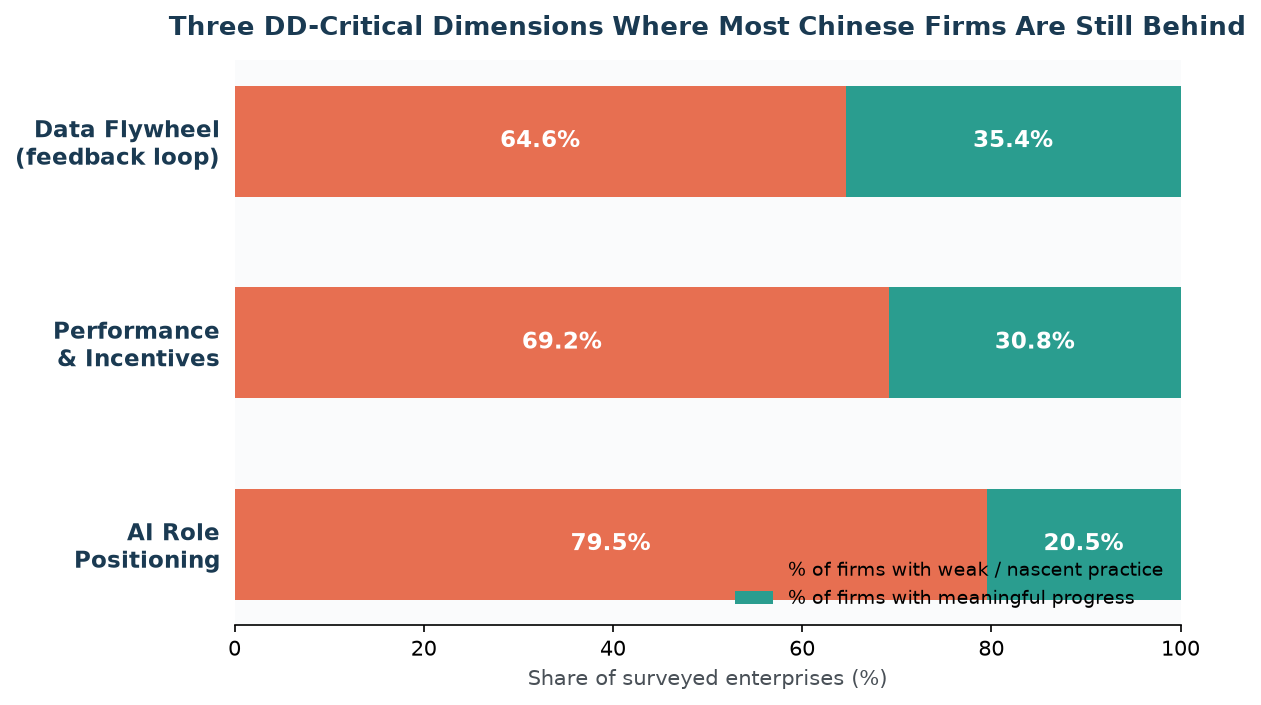
The first of the three weakest dimensions is AI Role Positioning, with an average score of just 1.98 out of 4. What that number captures is not whether employees have AI tools — most do — but whether leadership has actually rethought which business processes AI sits in the middle of.
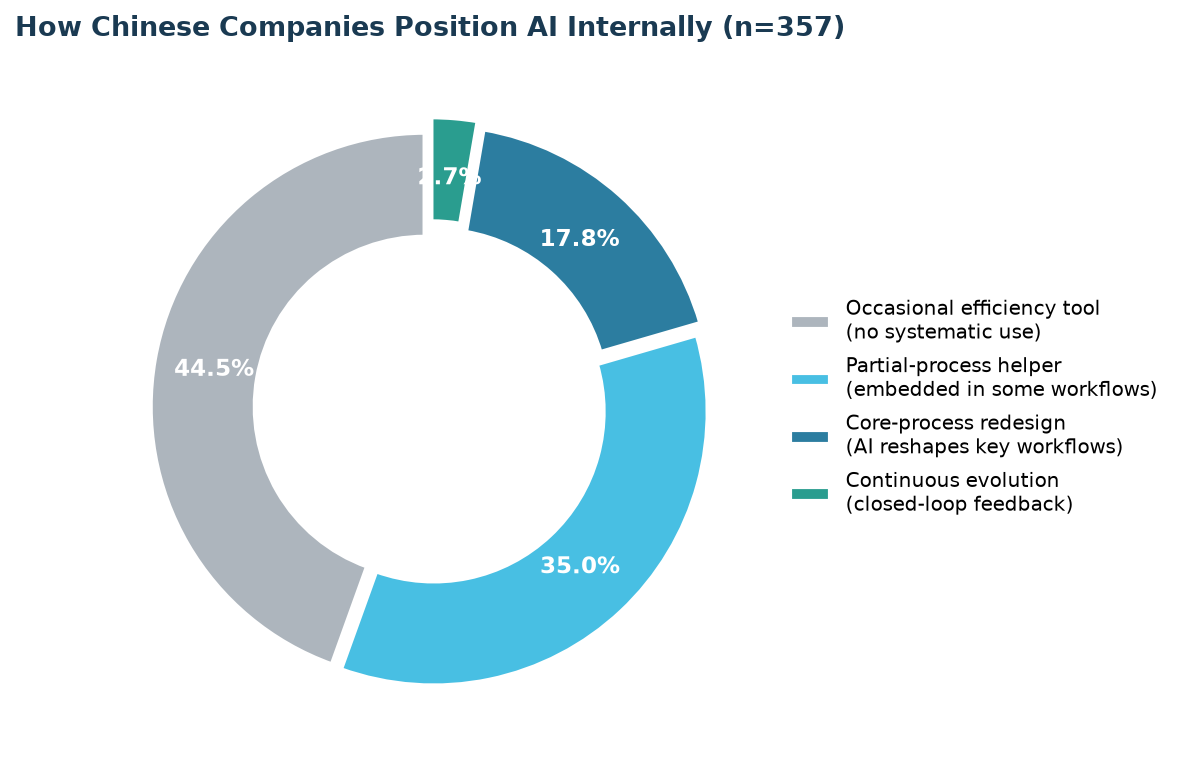
The breakdown is sobering:
- 44.5% of firms treat AI as an occasional personal productivity tool — employees use it on their own, with no systematic role in formal processes.
- 35.0% have embedded AI as a helper inside a few specific processes (for example, customer-service reply drafting or basic document review), but have not redesigned those processes around it.
- Only 17.8% have re-engineered core business processes so that AI is part of the default operating model.
- A tiny 2.7% run a closed-loop system where usage, feedback and model improvement continuously reinforce each other.
Shallow AI positioning is therefore less a “tech backwardness” signal than an operational-opacity signal. If your business depends on reliable SOPs, audit trails, or integration with your own digital systems, a partner stuck in the “occasional tool” tier will consistently create friction that does not show up on a business-license extract.
Red Flag 2: Weak Performance Traction Reveals Immature Management Systems
The second weakest high-cost dimension, Goal & Performance Incentives, scores 1.93 out of 4. The report finds that 69.2% of Chinese enterprises have not yet systematically integrated AI application or AI-enabled outcomes into their goal and performance-management systems. Only 25.9% report that AI performance has actually influenced employee ratings, bonuses or promotions.
Why should a foreign partner care about a Chinese company’s incentive design? Because incentives are where management rhetoric meets operational reality. A company that announces an “AI-first” strategy in its annual speech but does not adjust how teams are measured and paid is, in practice, not running an AI-first company. It is running a traditional company with a good communications team.
From a cross-border partnership perspective, weak performance traction around AI correlates with three practical risks:
- Pilot-to-production failure. Without incentives, AI projects are championed by one or two enthusiasts. When those people leave or get reassigned — common in the fluid Chinese labor market — the project quietly dies. Your joint project, which was scoped around the new AI-driven workflow, is quietly rolled back to manual.
- Unfinished digital transformation. Firms that cannot be bothered to update KPIs for AI are almost always the same firms whose broader management systems are still semi-manual. Expect inconsistent reporting formats, last-minute data pulls, and difficulty mapping your Western-style KPIs onto their internal metrics.
- Higher integration cost on your side. Every hour your own team spends reformatting Chinese-side spreadsheets, chasing signatures on WeChat, or correcting duplicated entries is a cost that should have been priced in during DD — but rarely is, because the underlying cause (low management digital maturity) is invisible in standard filings.
Red Flag 3: No Data Flywheel Means Persistent Information Opacity
The third signal is the most directly relevant to cross-border trust: whether the company has closed an AI data flywheel. The report finds that 64.6% of firms have not formed a positive feedback loop between AI usage, data capture and process improvement, and only 2.7% have reached a sustained continuous-evolution stage.
A closed flywheel is a deceptively simple idea. It means: when an employee uses an AI tool, the outputs, corrections, over-rides and downstream outcomes are captured; that data is fed back to improve the prompt, model or workflow; the improved system is redeployed; and the cycle repeats. To an outsider this sounds like a technical detail. It is not — it is a disclosure-and-traceability signal.
Companies without a flywheel almost always share three traits that matter to overseas partners:
- Operational data is fragmented. Production, quality, logistics and customer data live in separate silos or personal machines. There is no single source of truth — which means the numbers you get during DD, and the numbers you get six months later, may simply come from different spreadsheets.
- Decisions are not auditable. If a quality defect, delivery miss or compliance incident happens, the company cannot reliably reconstruct what the system recommended, who over-rode it, and why. For partners subject to FCPA, UK Bribery Act, EU CSRD or supply-chain due-diligence laws, this is a serious liability.
- Improvement is linear, not compounding. A flywheel firm gets better faster over time; a non-flywheel firm improves only when a manager heroically intervenes. Over a multi-year contract, the performance gap widens dramatically.
Your 6-Item AI Organizational Readiness Due-Diligence Checklist
The good news is that you do not need access to a Chinese company’s internal HRIS to form a reliable view of its AI organizational maturity. Many of the signals are visible from outside — if you know where to look, and if your China-side research partner is tasked with looking for them.
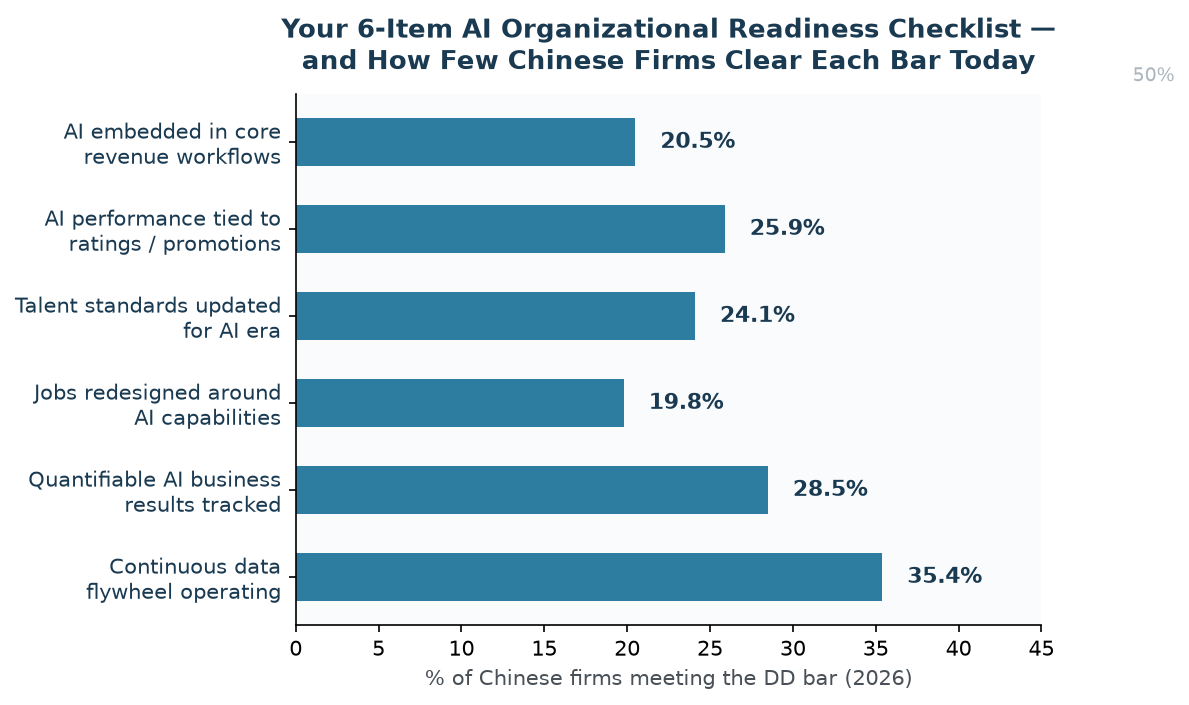
These signals can be triangulated from a blend of public sources: job boards (Lagou, Zhaopin, Boss Zhipin, Liepin), executive interviews in Chinese trade media, patent and software-copyright filings, tender documents, company annual reports and social-media posts, employee reviews on Kanzhun/Maimai, supplier case studies, and — when appropriate — structured reference interviews conducted in Mandarin by a team on the ground.
| Readiness tier | What you will observe | Operational implication for your partnership |
|---|---|---|
| Bystander (~55% of firms) | AI as individual productivity widget; no incentive linkage; no job redesign; no quantified results. | Expect manual workarounds, inconsistent reporting, and heavy integration burden on your own team. Higher surprise-risk over a 2–3 year horizon. |
| Explorer (~22% of firms) | Mechanisms in place (AI lead, training, committee); some pilots with results; limited incentive and job redesign. | Promising partner, but execution depends on a few champions. Build contractual milestones that survive staff turnover. |
| Leader (~21% of firms) | AI embedded in core workflows; incentives and talent standards updated; quantified results; working feedback loop. | Lower integration cost; more transparent reporting; better compliance posture. Typically worth prioritizing even at a small price premium. |
| Continuous evolver (~2.7%) | Closed flywheel; organization redesigns itself around AI on an ongoing basis. | Rare, but operationally excellent partners. Compounding improvement over the life of the contract. |
How ChinaBizInsight Helps You Layer AI Readiness into Partner Vetting
Traditional Chinese public registries — the National Enterprise Credit Information Publicity System, trademark and patent databases, court judgment platforms — are designed to record static facts: registered capital, legal representative, IP ownership, litigation history. They do not, and will not anytime soon, tell you whether a target’s CFO has actually tied bonuses to AI outcomes, or whether the factory floor runs on paper travelers or a closed-loop AI-driven MES.
That is why ChinaBizInsight’s field-research model exists. We combine official registry data, on-the-ground Mandarin-language research, and structured cross-checks into English-language reports tailored for overseas decision-makers.
For clients who want AI organizational readiness factored into partner selection, two of our existing products are particularly relevant:
- Professional Enterprise Credit Report. Our most comprehensive profile of a Chinese target — corporate structure, beneficial ownership, key-executive background and risk history, litigation and administrative-penalty records, IP portfolio, financial indicators where available, operational site verification, and industry sentiment. The AI Organizational Readiness module can be added as a dedicated section, scoring the target against the six-item checklist above and placing it into one of the four readiness tiers.
- Financial & Tax Credit Report. For transactions where financial transparency matters most — supplier credit terms, JV structuring, M&A — our finance-and-tax report digs into tax filings, VAT-payment patterns, financial statement reliability and banking signals. AI readiness findings are cross-referenced against financial discipline to flag companies where “AI-first” marketing is masking underlying reporting weaknesses.
Ready to look beyond the financials?
Whether you are onboarding a new Chinese supplier, evaluating a JV partner, or running pre-investment diligence, our English-speaking team on the ground in China can deliver a complete picture — including AI organizational readiness.
- Moka AI, 2026 China Enterprise AI Organizational Transformation Capability Report (2026). Based on 263 structured questionnaires and 94 on-site enterprise diagnostics, covering 357 Chinese enterprises across finance, technology/internet, manufacturing, retail, healthcare and energy.
- The University of Hong Kong (HKU) & Deloitte China, China AI Adoption Index 2026, cited within the Moka AI report, identifying organizational/cultural barriers (50%) and execution gaps (47%) as the primary reasons executives believe AI value is not being fully realized.
- Li Zhifei & Gao Jia, Super Organization (超级组织), referenced in the Moka AI report for organizational-redesign theory in the AI era.
ChinaBizInsight
Your strategic bridge to transparent business in China.