
China’s Consumer Robot Dog Market: Falling Prices and What They Mean for Global Buyers
A practical sourcing and due-diligence guide for overseas retailers, cross-border sellers, and individual buyers — September 2026
In this guide
- From ¥450,000 to ¥5,000: A Decade of Price Collapse
- Why Prices Are Falling: The Four Cost Levers
- The 2026 Price Ladder: What Your Money Buys
- Market Forecast: 700,000+ Units by 2030 at 79% CAGR
- The Reality Check: The “Use Case Gap” Still Unsolved
- The RaaS Wave: Why 40% of Rental Inventory Is Robot Dogs
- Risks When Buying from China: Red Flags Distributors See
- How to Verify a Chinese Robot Dog Supplier Before Paying
- References
Just three years ago, a “robot dog” was a novelty item you saw at tech exhibitions, priced like a used car. Today you can buy a credible Chinese quadruped for under $1,500 on Tmall, and Wang Xingxing — founder of industry leader Unitree Robotics — has publicly said the price will keep falling to ¥3,000–4,000 (roughly $420–$560). For overseas retailers, dropshippers and hobbyists, this is the moment consumer robot dogs move from “geek toy” to mass-market SKU. It is also the moment buying from China gets riskier: the same supply chain that is driving prices down has flooded Alibaba, AliExpress and independent B2B portals with copycat vendors, shell exporters and sellers who cannot actually deliver. This guide walks you through where the market stands in late 2026, why prices are collapsing, and what to verify before wiring a deposit.
From ¥450,000 to ¥5,000: A Decade of Price Collapse
The first commercially sold Chinese quadruped robots appeared around 2016–2017, built on university research spinoffs and priced close to half a million yuan. For context, Boston Dynamics’ Spot launched internationally at $74,500 in 2019, and Chinese vendors were competing in roughly the same ¥200,000+ bracket.
What happened next is one of the most dramatic cost-down stories in consumer hardware this decade. Domestic supply chains matured under national “strong-chain, supplement-chain” industrial policy, electric-motor companies scaled frameless torque motors, harmonic-drive makers such as Laifual drove reducer prices from more than ¥1,500 per unit to under ¥300, and lidar makers Hesai and RoboSense collapsed 3D-sensor costs from tens of thousands of yuan to a few hundred.
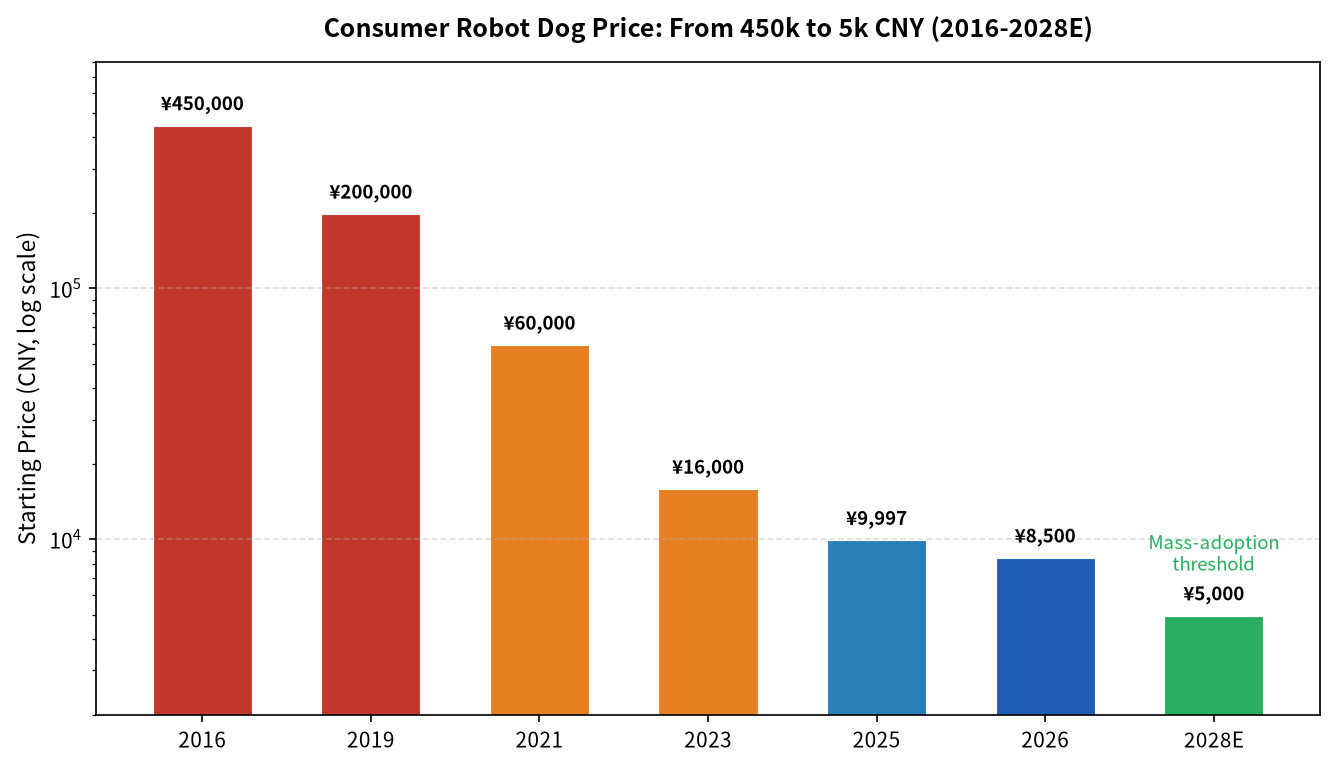
Figure 1 — Entry-level consumer robot dog starting price in China, 2016–2026 and industry forecast to 2028. Source: Yiou Intelligence, GGII, Unitree official pricing, author compilation.
By 2021, Unitree’s Go1 had already broken the ¥10,000 floor at roughly ¥16,000. In July 2023 the Go2 launched at ¥9,997 (about $1,400 at today’s exchange rate). In April 2026 Unitree opened its first direct-operated offline store on Wangfujing Street in Beijing, where consumers can walk in and take home a Go2 series robot for “just over 10,000 yuan” and a G1 humanoid for up to ¥130,000, all in stock. Multiple industry research houses — including Yiou Intelligence’s China Quadruped Robot Commercialisation Report 2026 and GGII’s 2026 China Quadruped Robot Industry Blue Book — now identify a ¥5,000–8,000 mass-adoption threshold, which top vendors are expected to cross within the next 12–24 months.
(¥450k → ¥8.5k entry)
price band, 2027–2028
sales by 2030 (units)
CAGR 2025–2030
Why Prices Are Falling: The Four Cost Levers
It is not just volume. Yiou Intelligence breaks the cost of a consumer robot dog down into six blocks, and the single largest — joint modules, comprising 12 high-torque servo actuators — accounts for 40% of the entire BOM. That makes joint modules the only component where a 1-point cost saving translates almost directly into a 1-point retail price cut.
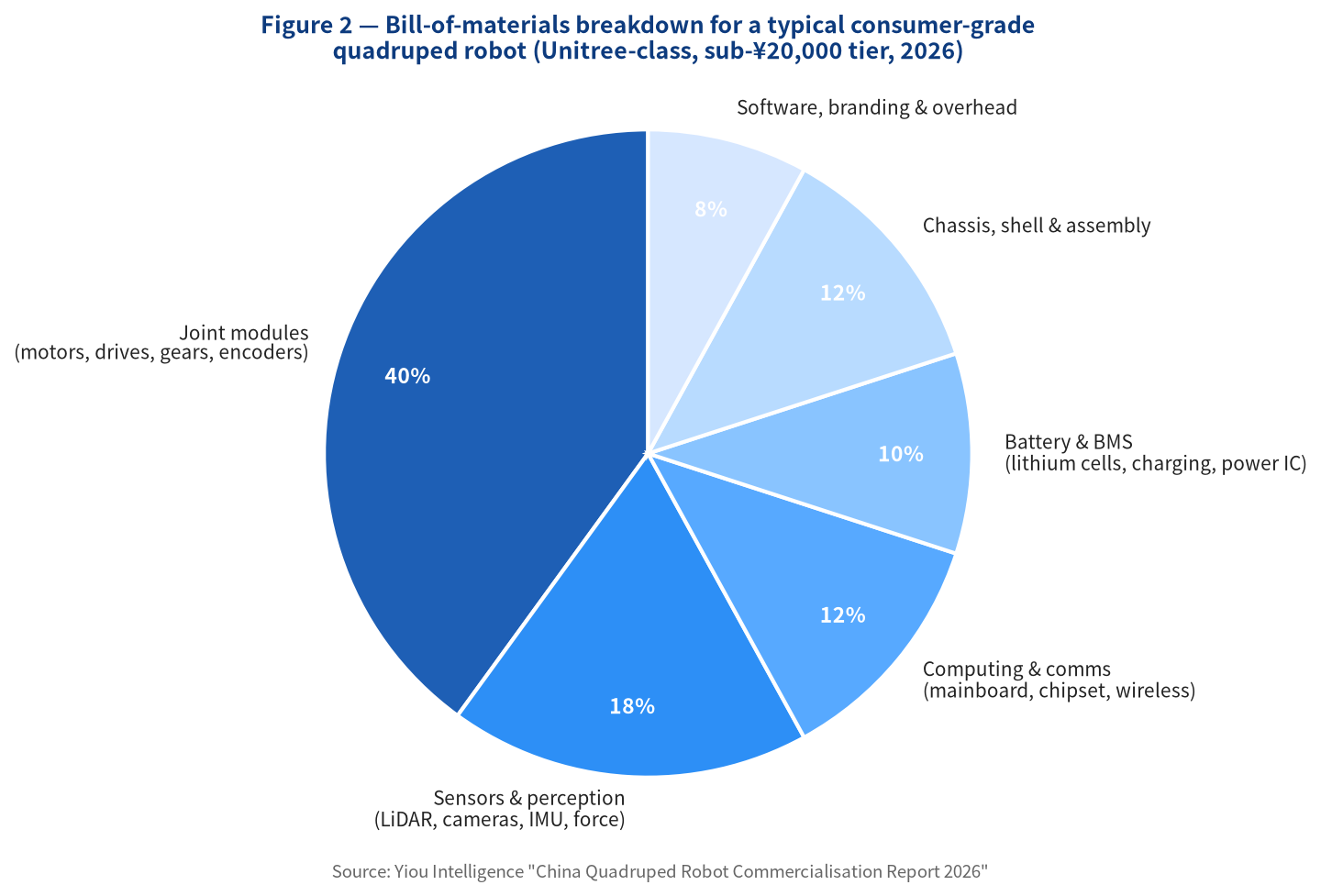
Figure 2 — Bill-of-materials breakdown for a typical consumer-grade quadruped robot (Unitree-class). Source: Yiou Intelligence “China Quadruped Robot Commercialisation Report 2026”, p.13.
Four structural forces are driving costs down simultaneously:
- Core-component localisation beyond 75–80%. Frameless torque motors are now more than 85% localised; joint modules overall are 80–90% localised; structural parts, chassis, wiring and connectors are essentially 100% domestic. Only high-resolution encoders (under 35% localisation at the high end), some servo drives (35–45%), and six-axis force sensors (27–30%) still rely meaningfully on imports.
- Vertical integration at the leading OEMs. Unitree designs and builds more than 90% of its hardware in-house — motors, reducers, encoders, sensors and its own 4D ultra-wide-angle lidar — turning what used to be purchased components into raw-material buys. The company openly describes this as its “Xiaomi-style” path to mass affordability.
- Scale amortisation of NRE and tooling. Unitree alone shipped roughly 23,700 units in 2024 (GGII), capturing about 70% of the global consumer market — volumes Boston Dynamics never approached with Spot. The 2025 full-year global market reached ~58,000 units, and 2026 H1 alone shipped 49,000 units (IDC), doubling run-rate again.
- Architecture-level redesign. Yiou identifies the next cost-down phase not as “buy cheaper parts” but as architecture and motor-technology changes: moving from distributed joint controllers to centralised drives, swapping out harmonic drives for cycloidal or planetary designs in consumer SKUs, and shifting software value from embedded code to cloud AI.
What this means for buyers: the cheapest robot dogs on Alibaba at ¥2,000–3,000 today are not the result of a breakthrough — they are almost always units built with lower-torque hobby servos, no lidar, no real force sensing, and firmware that cannot survive a real fall. If a price looks too good to be true in late 2026, it is almost certainly a kit-style or clone product, not a Unitree-class device.
The 2026 Price Ladder: What Your Money Buys
Prices below are typical starting prices for legitimate branded products in China as of Q3 2026, drawn from official Tmall/JD stores and manufacturer websites. Landing costs for overseas buyers will add freight, import VAT/duty and the distributor’s margin.
Entry / Educational Kits
¥1,000 – ¥4,000
($140 – $560)
- 8–12 DoF, plastic chassis
- Hobby servos or basic metal gears
- ESP32 / STM32 control, no lidar
- Open-source firmware (Hiwonder, Huaner, XiaoR)
- Use case: STEM education, maker projects
Mainstream Consumer
¥8,000 – ¥16,000
($1,100 – $2,200)
- 12 high-torque joints, 45 N·m peak
- 4D lidar + depth camera (Go2-class)
- AI voice, OTA, 3D mapping
- Unitree Go2 Air/Pro, Vbot BoBo Pro
- Use case: companion, photography, developer
Flagship / Enthusiast
¥16,000 – ¥60,000+
($2,200 – $8,400+)
- Go2-W / Edu, B2 industrial-variant
- Longer runtime, higher payload, SDK
- Some models carry TÜV Rheinland CE
- Use case: research, light commercial, film
Note that the overseas retail price of a Unitree Go2 Air is currently around $2,800 on Unitree’s international channels, versus ¥9,997 ($1,400) domestic — roughly a 2× spread. Even after shipping and duties, grey-market parallel import has until recently been attractive, though Unitree has been tightening channel control and warranty enforcement in 2026.
Market Forecast: 780,000 Units by 2030 at 79% CAGR
According to GGII’s 2026 China Quadruped Robot Industry Blue Book, China sold 57,600 quadruped robots in 2025, of which the consumer/education segment made up the largest volume share (about 60% of units, per IDC H1 2026 data) but only about a third of revenue. The research house projects that by 2030 annual Chinese sales will approach 780,000 units with a market size of more than ¥16 billion, implying a 2025–2030 CAGR of about 68% in volume terms; purely on the consumer/education sub-segment the implied CAGR is roughly 79%, in line with the forecast cited in the commercialisation report.
| Year | China Unit Sales (est.) | Consumer/Ed share of units | Avg consumer price (¥) | Key inflection point |
|---|---|---|---|---|
| 2023 | ~12,000 | ~70% | ~16,000 | Unitree Go2 launches at ¥9,997 |
| 2024 | ~34,000 | ~68% | ~12,000 | Unitree ships 23,700 units (GGII) |
| 2025 | ~57,600 | ~63% | ~10,000 | Rental market ignites after CCTV Gala |
| 2026F | ~90,000–100,000 | ~60% | ~8,500 | First ¥5k–8k SKUs expected |
| 2030F | ~780,000 | ~55% | ~5,000–6,000 | Mass-adoption threshold crossed |
For comparison, IDC reported 49,000 units shipped globally in H1 2026 alone, with China-based manufacturers accounting for more than 90%. The four Chinese leaders — Unitree, DEEP Robotics, AGIBOT and Micbot — together took 76% of global H1 share. Put simply, if you are selling a consumer quadruped robot anywhere in the world in 2026, it was almost certainly designed and contract-manufactured in China.
The Reality Check: The “Use Case Gap” Is Still Unsolved
It would be irresponsible to present the falling-price story without a cold look at demand. Industry analysts have begun to flag that 2026 is the year the consumer segment moves from “explosive growth” into an “application deepening period” (Puhua Youce, Yiou). The uncomfortable truth is that most consumer robot dogs sold today are still bought as tech novelty, emotional companion, or high-end toy, not because they solve a repeatable daily chore.
🐾 Emotional companion / “digital pet”
Primary driver for family buyers. Vitadog’s “Big Head” launch sold 6,540 units with 86% two-week retention — unusually high for the category — by leaning into AI personality and voice interaction.
📸 Content creator / social media prop
Short-video creators on Douyin/TikTok and commercial photographers use Go2-class units for follow-cam, event photography and viral clips. Drives demand for Go2 Pro and Air.
🎓 STEM education / developer kit
Schools and universities buy EDU versions for robotics courses. Hiwonder, Huaner and other entry-kit makers live almost entirely in this segment.
🏪 “Trendy tech product” for retail
Offline stores, cafés and brand activations buy units as showroom attractions — bridging consumer sales with the much larger commercial-rental market.
Buyer beware: Unlike a drone (which takes photos) or a robotic vacuum (which cleans floors), no universal “killer use case” has yet emerged for a home robot dog. Initial activation rates are high; 90-day active usage drops off noticeably. If you are a retail buyer, plan assortment around gifting seasons (Christmas, Chinese New Year, graduation) and around content-creator bundles, rather than assuming recurring household replacement demand.
The RaaS Wave: Why 40% of Rental Inventory Is Robot Dogs
If ownership demand is still finding its footing, temporary access is booming. According to iiMedia Research, China’s robot rental market will cross ¥10 billion (~$1.4 billion) in 2026, a roughly 10× jump from ¥1 billion in 2025. More than 150,000 enterprises now list robot rental as a business scope (per Aiqicha / Qichacha data cited by industry media), and new rental platforms — Qingtianzu (backed by AGIBOT), Wanji Yizu, Jishizu, and JD.com’s own rental service — have all launched since late 2025.
Within that rental pool, quadruped robots account for roughly 40% of total inventory, ahead of humanoids, delivery robots and cleaning robots. The reason is practical: robot dogs are easier to transport than humanoids, cheaper, less prone to falling over in public, and novel enough to draw crowds at shopping centres, corporate events and weddings.
| Metric | 2025 (Feb peak) | 2026 (Q3) | Trend |
|---|---|---|---|
| Daily rental — entry consumer dog | ¥800 – ¥1,500 | ¥399 – ¥800 | Down 50%+ |
| Daily rental — Unitree-class consumer | ¥1,500 – ¥3,000 | ¥800 – ¥1,500 | Down ~50% |
| Daily rental — humanoid (e.g. Unitree G1) | ¥15,000 – ¥20,000 | ¥1,796 – ¥5,000 | Down 70–80% |
| Largest platform inventory | <500 units | 3,000+ (Qingtianzu) | 6× growth |
| Typical payback period | <10 days | 3–6 months | Normalising |
Rental is also quietly becoming a distribution channel. A shopping mall that rents a fleet of robot dogs for a month-long activation often ends up buying a few units afterwards; event companies that begin by renting become repeat dealers. For overseas distributors, partnering with a Chinese rental platform or becoming a regional “RaaS franchisee” can be a lower-risk entry than taking container loads of inventory on day one.
Risks When Buying from China: Red Flags Distributors See
The same combination of falling prices, booming demand and low entry barriers that makes the market exciting also makes it a magnet for bad actors. Based on disputes publicly filed on Alibaba Trade Assurance, 1688 complaint records and cases ChinaBizInsight has reviewed with trade-law partners, here are the most common problems overseas buyers run into.
🚩 Seven Red Flags When Sourcing a Chinese Robot Dog
- “Factory” that is actually a trading company. Many Alibaba storefronts use stock photos from Unitree, DEEP or Weilan but ship a lower-spec clone. Registered business scope may say “electronic products trading” rather than “robot manufacturing”.
- Prices 30%+ below the official distributor price. Unitree sets relatively tight international MAP pricing; a quote that is dramatically lower almost always means a used unit, a demo unit, or a non-authentic product.
- Trademark-infringing listings. Listings that use the word “Unitree” or “Go2” in the title but ship a no-name unit, or that clone the Go2 chassis design, are common. This exposes importers to customs seizure in the EU, US and UK.
- Missing CE / FCC / UKCA certification. Legitimate exporters to Europe or North America need CE-RED, FCC Part 15, RoHS and (from mid-2027 for the EU) the new Cyber Resilience Act conformity requirements. A vendor who cannot produce a verifiable test report from a lab such as TÜV, SGS or Intertek is cutting corners.
- Unrealistic delivery dates. If a vendor says they can ship 500 units in 7 days but their paid-in capital is ¥500,000 and they have three employees, the order is almost certainly being brokered from a third factory.
- Deposit requests to personal accounts. Requests to wire T/T to a personal name, a Hong Kong account unrelated to the contract entity, or a crypto wallet are statistically overwhelming indicators of fraud.
- No after-sales capability. Consumer robot dogs need spare joints, battery replacements and firmware updates. A vendor that cannot name a domestic service partner or provide a warranty policy will leave your customers stranded.
How to Verify a Chinese Robot Dog Supplier Before Paying
Verifying a Chinese exporter does not require a private investigation firm — most of what you need sits in official government registries, but they are only available in Chinese and require a China-side mobile number for full access. Here is the practical five-step framework we recommend to every overseas buyer placing an order above $5,000.
| # | Step | What you check | Official source / tool |
|---|---|---|---|
| 1 | Confirm legal identity | Exact registered Chinese name, Unified Social Credit Code, legal representative, registered capital (paid-in vs subscribed), establishment date, registered address, business scope — confirm they are actually licensed to manufacture robots, not just trade electronics. | National Enterprise Credit Information Publicity System (国家企业信用信息公示系统) via an official enterprise credit report. |
| 2 | Check IP ownership | Verify that the company (not an unrelated shell) actually owns the trademarks, design patents and invention patents behind the product. Confirm they are not cloning Unitree’s or Boston Dynamics’ trade dress. | CNIPA trademark / patent databases, or ChinaBizInsight IP search. |
| 3 | Pull risk and litigation records | Look for customs penalties, product-quality lawsuits, dishonest-execution judgments (失信被执行人), administrative penalties from SAMR (market regulator), and unresolved contract disputes with previous overseas buyers. | China Judgements Online, Credit China, via a risk-focused credit report. |
| 4 | Verify certifications | Ask for CE/FCC/RoHS certificate numbers and cross-check them against the issuing lab’s online verification portal. Fake PDF certificates are extremely common; always verify directly with the lab. | TÜV, SGS, Intertek, CQC online databases. |
| 5 | Apostille / notarise export documents | For distributors who need to register products with local telecoms or customs authorities (e.g. EU CE declarations, Saudi SASO, Nigeria SON), you will need Chinese-issued certificates apostilled for use abroad. | China Notary Public Office + Ministry of Foreign Affairs apostille, via ChinaBizInsight apostille services. |
Cross-border sourcing works best when you treat verification as a pre-contract step, not a post-fraud remedy. A ¥300–500 credit report pulled before a $50,000 wire is the cheapest insurance policy in cross-border trade. For small e-commerce sellers testing SKUs under $2,000, even just confirming that the company’s registered name matches the Alibaba storefront, that it has been operating for at least two years, and that paid-in capital is at least ¥1 million will eliminate the majority of scams.
Importing robot dogs from China? Verify the supplier first.
Before you place a purchase order, sign a distribution agreement or wire a deposit, verify the company through official Chinese government records — not just their own storefront. ChinaBizInsight retrieves independent, English-language enterprise credit reports from China’s national business registry, runs intellectual-property checks, and provides notarisation and apostille services for Chinese export documents — so your certifications clear customs in Europe, North America and the Middle East on the first try.
References
- Yiou Intelligence, China Quadruped Robot Commercialisation Research Report 2026, September 2026 (cost structure, localisation rates, ¥5,000–8,000 threshold).
- IDC, Worldwide Commercial Quadruped Robot Market Share Report, H1 2026, September 2026 (49,000 units; 90%+ China share).
- GGII (Gaogong Industry Research Institute), 2026 China Quadruped Robot Industry Blue Book (57,600 units 2025; ~780,000 units by 2030; ¥16 bn market).
- Baidu Baike, “Unitree Go2” entry; aiqicha.baidu.com Unitree Go2 pricing (¥9,997, $2,800 overseas).
- Global Times, “Unitree sells robots starting at around 10,000 yuan at its first directly operated offline store”, 30 April 2026.
- Lei Keji / Chuangyebang / 36Kr, “降价到三四千元,宇树科技要用小米模式让机器狗普及?”, 21 February 2025 (Wang Xingxing ¥3,000–4,000 target; vertical integration strategy).
- iiMedia Research, cited in China.com / The Paper, “机器人租赁市场迎来爆发式增长”, March–September 2026 (¥10 bn rental market; quadruped 40% of rental inventory).
- Jiemian News / Rongzhong Finance, “机器人租赁:百亿RaaS新物种”, 20 May 2026 (pricing evolution from ¥15,000–20,000/day to ¥3,000–5,000/day; platform data).
- Puhua Youce, “具身智能引爆四足机器人:十五五新质生产力核心赛道深度解析”, 27 February 2026 (market entry into “application deepening period”; technology trends).
- Baolu Education, citing GGII and industry case studies, “四足机器人率先商业化落地,2026年市场规模超35亿元”, 27 September 2026 (Vitadog launch numbers; deployment cases).
- Sohu Tech reviews of Vbot BoBo Pro, Hiwonder MechDog and Unitree Go2 Air, September–October 2026 (specifications, pricing and real-world performance).
ChinaBizInsight
Your strategic bridge to transparent business in China.