
China’s Enterprise AI Transformation in 2026: What Overseas Businesses Need to Know About Organizational Readiness
Executive Summary: China Has Crossed the Starting Line — But Not Much Further
If you are evaluating a Chinese supplier, distributor, joint-venture partner, or acquisition target in 2026, there is a new dimension worth adding to your due-diligence checklist: how ready is the organization itself to actually use AI, not just how many AI tools it claims to have deployed.
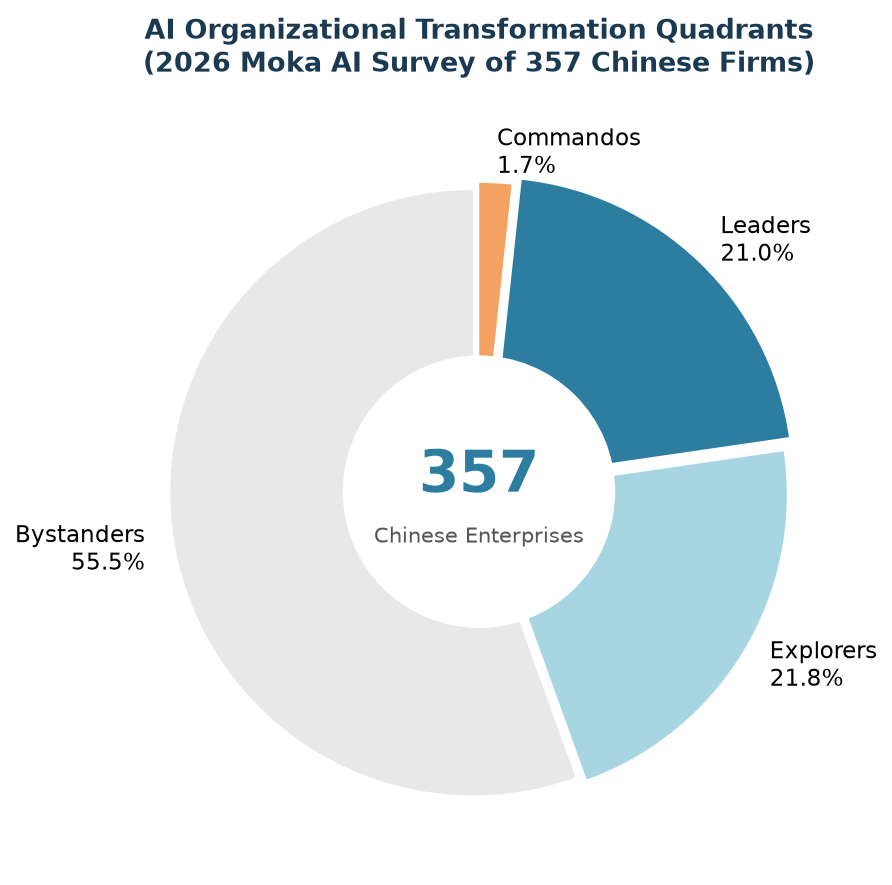
According to the 2026 China Enterprise AI Organizational Transformation Capability Report, published by Moka AI (a leading Chinese HR-technology company) based on structured surveys of 263 firms plus on-site diagnostic material from another 94 — a total of 357 Chinese enterprises spanning finance, technology, manufacturing, retail, healthcare and energy — the country’s average “AI Organizational Transformation Capability Index” sits at 54.8 out of 100.
That score maps clearly onto the report’s conclusion: Chinese firms as a whole have moved past the “should we use AI?” debate, but they have not yet reached a stage where AI is stably embedded in core processes, decision rights, or accountability structures. They are, in the report’s words, “past the starting line, but not yet mature” — an early-stage majority.
Low-Cost Moves Are Done. High-Cost Reforms Have Not Really Started.
The most striking pattern in the data is not resistance to AI — it is the precise opposite. Chinese employees and executives have, by and large, already adopted the easy parts of AI. What they have not done is the uncomfortable part: redistributing decision rights, rewriting job descriptions, and re-linking compensation to AI-era outcomes.
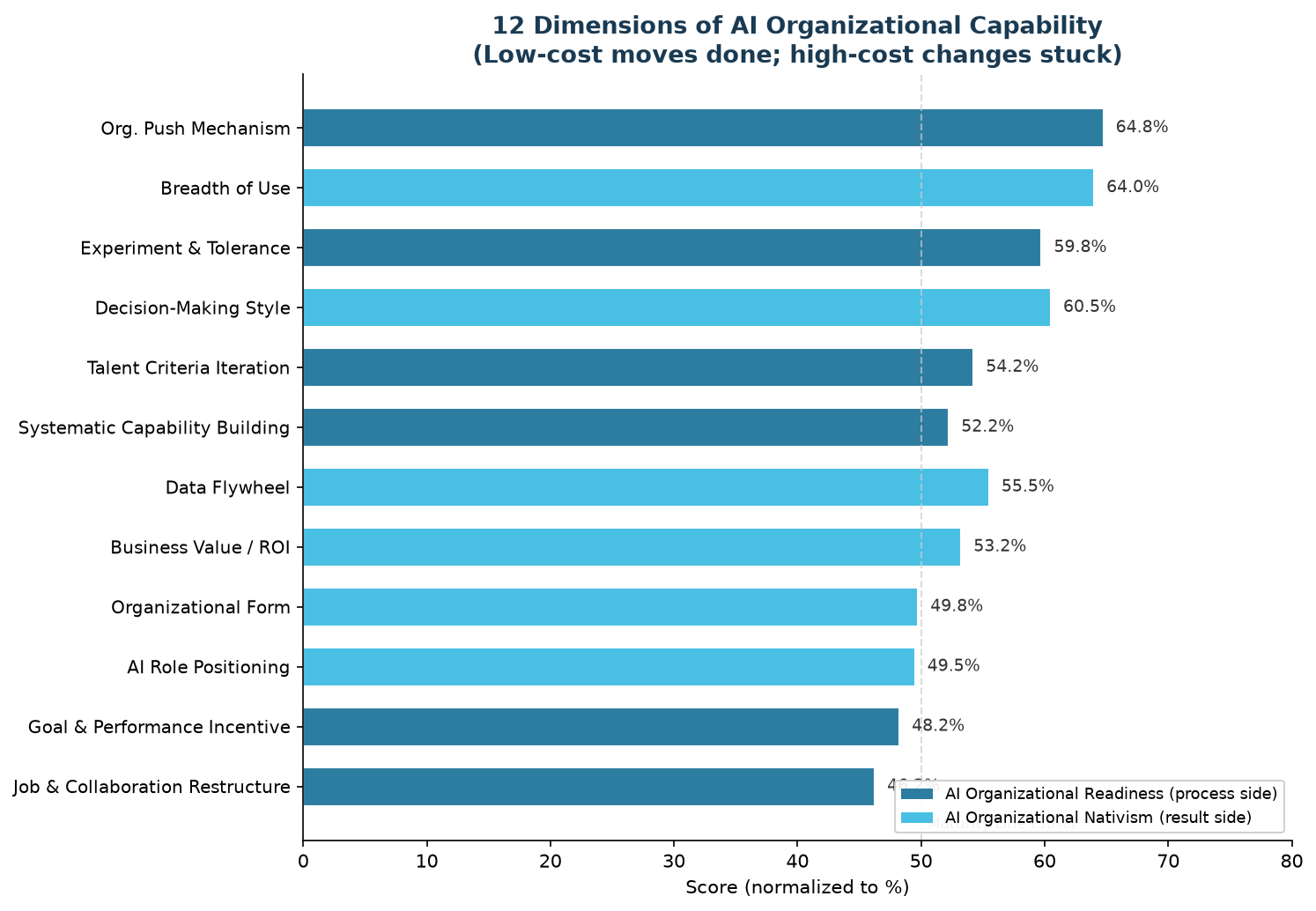
The report breaks organizational AI maturity into 12 dimensions grouped under two axes — AI Organizational Nativism (how deeply AI has actually changed work and results) and AI Organizational Readiness (how well the talent, incentives and governance system supports ongoing AI evolution). When all 12 dimensions are scored on a 1–4 scale and normalized, a clean gap appears between the reversible, symbolic actions and the irreversible, power-shifting ones.
The four “stuck” dimensions — and why they matter to you
| Dimension | Avg. score (1–4 scale) |
What it means for overseas partners |
|---|---|---|
| Job & Collaboration Restructure | 1.85 | 80.2% of firms have not systematically re-examined which tasks AI can absorb, augment or replace. Job descriptions and hand-offs between teams remain pre-AI. Expect inconsistent response quality on cross-border projects that depend on reliable internal workflows. |
| Goal & Performance Incentives | 1.93 | Only 25.9% of firms actually factor AI usage or AI-enabled outcomes into ratings, bonuses or promotions. When AI gains are not tied to pay, they rarely scale beyond pilot teams. |
| AI Role Positioning | 1.98 | 79.5% of firms still treat AI as an occasional productivity widget or a partial-process helper. Only 20.5% have redesigned core business processes around AI — a useful signal of how resilient and data-driven a partner’s operations will be at scale. |
| Organizational Form | 1.99 | 72.3% of firms have made no substantial change to organizational structure or roles because of AI. Only 4.6% report systematic creation, merger or redesign of positions. Reporting lines and accountability stay frozen in pre-AI form. |
By contrast, the two highest-scoring dimensions are the least threatening ones: organizational push mechanisms (2.59) — meaning senior leaders have given speeches, formed cross-functional committees, or purchased toolkits — and breadth of use (2.56), meaning employees already have AI accounts and are using them in daily work.
The numbers behind that warning are stark: 71.5% of firms cannot quantify the business results AI delivers, and only 2.3% can systematically attribute AI’s contribution to key performance indicators and track it over time. A further 64.6% have not closed the “data flywheel” — they are not feeding usage and feedback back into model or process improvement, so AI remains a one-off productivity trick rather than a compounding advantage.
This is not uniquely a Chinese problem — a 2026 HKU–Deloitte study cited in the report finds that organizational and cultural barriers (50%) and execution gaps (47%) outweigh technical limitations (39%) as reasons executives feel AI value is not being realized. But it matters disproportionately to overseas partners, who already face distance, language, and information asymmetry when assessing Chinese firms. A company that looks AI-advanced from a marketing deck may in practice still run on 2019-vintage manual hand-offs.
Industry Divergence: Tech and Finance Lead, But Bystanders Are Everywhere
The report also makes clear that AI organizational maturity is not evenly distributed. When the data is cut by sector, two industries pull clearly ahead: technology / internet and finance / insurance.
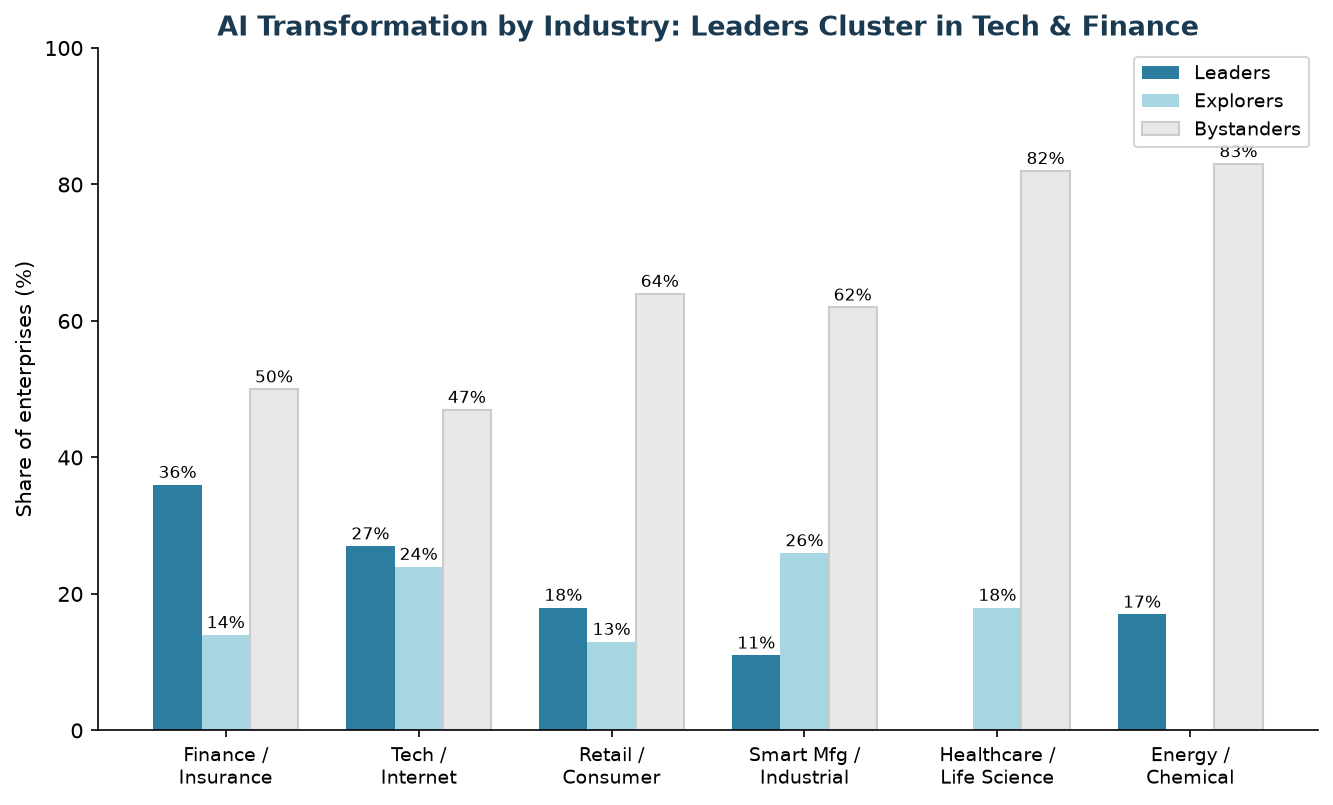
- Finance / insurance has the highest leader density, with 36% of firms in the Leader quadrant and another 14% as Explorers.
- Technology / internet follows, with 27% Leaders and 24% Explorers.
- In healthcare / life sciences and energy / chemicals, roughly 82–83% of firms are still Bystanders, reflecting heavier regulation, data sensitivity and offline core processes.
The Non-Linear Size Curve: Why Mid-Sized Firms Are Squeezed
Intuition suggests that bigger companies, with bigger budgets, would be further ahead. The data contradicts that intuition in an interesting way.
| Firm size | Leaders | Explorers | Bystanders | Pattern |
|---|---|---|---|---|
| Under 200 employees | 32% | 16% | 50% | Small teams move fast when the founder personally uses AI; short decision chains let them pivot quickly. |
| 200 – 1,000 employees | 15% | 23% | 60% | “Middle squeeze”: lost the agility of a small team, not yet running the systems of a large one. |
| 1,000 – 5,000 employees | 19% | 17% | 61% | Still in the squeeze zone; process debt accumulates faster than AI governance can be built. |
| 5,000+ employees | 20% | 27% | 53% | Highest share of Explorers — large firms invest early in mechanisms (HR systems, centers of excellence), even before full business results appear. |
For overseas companies sourcing from or partnering with Chinese firms, this is operationally relevant. A small Chinese factory or SaaS vendor with a founder who personally runs parts of the business on AI agents can deliver surprisingly consistent, data-rich service. A 1,000-person regional manufacturer, on the other hand, may look more “established” on paper but still run on spreadsheets, WeChat approvals and informal hand-offs — classic Bystander symptoms. And a large enterprise partner may say all the right things about AI in your kickoff meeting because it has the mechanisms, while measurable results in your specific business unit are still quarters away.
Why AI Organizational Maturity Is a New Due-Diligence Dimension
Traditionally, when an overseas firm vets a Chinese counterparty, it checks the basics: business license, registered capital, shareholder structure, litigation records, IP ownership, tax status, financials where available. Those checks are still necessary and will remain the foundation of any proper China business due diligence exercise.
But as AI reshapes how Chinese firms actually operate, three new correlations matter for cross-border risk and performance:
- Process discipline. Companies that have genuinely restructured jobs and incentives around AI almost by definition have documented, measurable workflows — which translates into more predictable lead times, fewer ad-hoc surprises and cleaner escalation paths for foreign partners.
- Data transparency. Closing the data flywheel (collecting usage feedback, attributing outcomes) requires a baseline of data hygiene. Firms that can do this for their own AI systems are much easier to integrate into your own reporting, audit and ESG pipelines.
- Compliance and governance. Building AI readiness mechanisms — talent standards, cross-functional AI governance, experimentation rules — correlates with stronger compliance cultures more generally. These are the firms less likely to surprise you with labor, environmental, or data-governance incidents mid-contract.
How to Add AI Organizational Readiness to Your China Due Diligence
AI readiness is not yet captured on any Chinese government registry. It will not show up on a standard National Enterprise Credit Information Publicity System (国家企业信用信息公示系统) filing. That is precisely why it needs to be added explicitly to the scope of a professional-level enterprise credit report or a custom due-diligence engagement. Based on the Moka framework, overseas teams should ask their China research partner to surface at least the following indicators:
| What to check | Practical signals in a Chinese company | Why it matters to you |
|---|---|---|
| Depth of AI application | AI used in core revenue-generating workflows, not only in back-office support; documented SOPs that reference AI tools. | Predicts operational reliability, response speed and consistency on your account. |
| Organizational push mechanism | Dedicated AI lead / cross-functional AI task force; budget line item; evidence of ongoing training (not a one-off launch event). | Distinguishes genuine commitment from marketing rhetoric. |
| Talent standards | AI proficiency included in hiring JD’s, performance reviews and promotion criteria for relevant roles; AI-native roles (e.g., AI workflow designer) actually exist on the org chart. | Correlates with the quality of staff you will actually be working with. |
| Job restructure evidence | New or redesigned positions tied to AI; evidence that repetitive tasks have been systematically automated rather than informally shoehorned into existing roles. | Reduces the risk that your project quietly collapses onto overloaded employees running manual workarounds. |
| Performance & incentive linkage | AI-enabled KPIs mentioned in internal performance documents or employee reviews; bonuses or promotions tied to measurable AI-driven outcomes. | Signals that AI adoption is institutionalized rather than dependent on one champion who could leave. |
| Quantified business value | Case studies, internal metrics or public statements showing measurable impact (cost saved, time reduced, quality uplift) attributable to AI. | Separates mature operators from pilots that will be quietly killed at the next budget cycle. |
A qualified China-side research partner can triangulate these signals from public sources (job postings, executive interviews, patent filings, published case studies, tender documents, social-media footprint of senior staff, and structured interviews where appropriate) and combine them with conventional credit, litigation and financial checks. The result is a partner portrait that reflects how Chinese business actually runs in 2026 — not how it looked a decade ago.
Vetting a Chinese partner in 2026?
Get a comprehensive picture — official records, key-person risk, litigation, financials, and AI organizational readiness — all from one English-speaking team on the ground in China.
- Moka AI, 2026 China Enterprise AI Organizational Transformation Capability Report (2026). Research based on 263 structured questionnaires and 94 on-site enterprise diagnostics, totaling 357 Chinese enterprises.
- The University of Hong Kong (HKU) & Deloitte China, China AI Adoption Index 2026, cited within the Moka AI report (executive survey on barriers to AI value realization).
- Li Zhifei & Gao Jia, Super Organization (超级组织), referenced in the Moka AI report for organizational redesign theory.
ChinaBizInsight
Your strategic bridge to transparent business in China.