
Introduction
In today’s globalized economy, partnering with Chinese companies offers immense opportunities for businesses worldwide. However, verifying the legitimacy and credibility of these partners is crucial to mitigating risks. One essential step in this process is ensuring that Chinese company documents are properly apostilled or legalized for international use. Whether you’re engaging in cross-border transactions, legal proceedings, or investment activities, understanding the apostille and legalization process is key to safeguarding your interests.
This guide will walk you through everything you need to know about apostilling or legalizing Chinese company documents, including the differences between the two processes, required steps, and common pitfalls to avoid.
What Are Apostille and Legalization?
Apostille and legalization are processes that authenticate documents for use in foreign countries. While they serve similar purposes, their applicability depends on whether the destination country is a member of the Hague Convention.
- Apostille:
- An apostille is a simplified certification process used for countries that are part of the Hague Convention Abolishing the Requirement of Legalization for Foreign Public Documents.
- It verifies the authenticity of the document’s signature, seal, or stamp.
- China is not a member of the Hague Convention, so apostilles are only applicable for documents destined for Hague member countries.
- Legalization:
- Legalization is a more complex, multi-step process required for non-Hague member countries.
- It involves authentication by Chinese notarial offices, followed by certification from the Chinese Ministry of Foreign Affairs and the embassy or consulate of the destination country.
Why Do You Need Apostille or Legalization?
Chinese company documents, such as business licenses, articles of association, and credit reports, are often required for:
- Establishing overseas subsidiaries or joint ventures.
- Legal proceedings in foreign courts.
- Applying for visas or work permits.
- Securing loans or investments from international institutions.
Without proper authentication, these documents may not be recognized abroad, leading to delays, legal complications, or missed opportunities.
Step-by-Step Process for Legalizing Chinese Company Documents
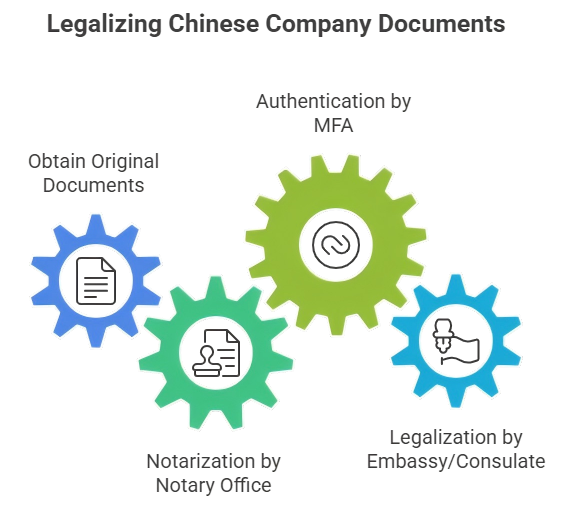
Since China is not a Hague Convention member, most international transactions require legalization. Here’s a detailed breakdown of the process:
Step 1: Obtain the Original Documents
First, secure the original documents you need to legalize. Common documents include:
- Business Licenses
- Articles of Association
- Enterprise Credit Reports
- Board Resolutions
- Tax Compliance Certificates
These documents can be retrieved from official sources like the National Enterprise Credit Information Publicity System. If you’re unsure how to obtain them, professional services like ChinaBizInsight’s Company Documents Retrieval can assist.
Step 2: Notarization by a Chinese Notary Office
All documents must be notarized by a local notary public in China. The notary will verify the authenticity of the documents and issue a notarial certificate in both Chinese and the required foreign language.
Step 3: Authentication by the Chinese Ministry of Foreign Affairs (MFA)
After notarization, submit the documents to the MFA or its local authorized offices for authentication. The MFA will affix a seal to confirm the notary’s signature is genuine.
Step 4: Legalization by the Destination Country’s Embassy/Consulate
Finally, the documents must be submitted to the embassy or consulate of the destination country in China. The embassy will verify the MFA’s seal and attach its own certification, making the documents legally valid in the destination country.
Special Case: Apostille for Hong Kong Documents
While mainland China is not part of the Hague Convention, Hong Kong is. If your documents are from Hong Kong, such as a Certificate of Incorporation or Business Registration Certificate, they can be apostilled for use in Hague member countries.
For assistance with Hong Kong document apostilles, explore ChinaBizInsight’s Hong Kong Services.
Common Challenges and How to Overcome Them
- Language Barriers:
- Official documents are often in Chinese. Ensure they are translated by a certified translator and notarized.
- Complex Procedures:
- The legalization process involves multiple government agencies, which can be time-consuming. Working with a professional service can streamline the process.
- Document Eligibility:
- Not all documents are eligible for legalization. For example, documents issued by certain institutions may require additional verification.
- Time Sensitivity:
- Legalization can take several weeks. Plan ahead to avoid delays in your international transactions.
Tips for a Smooth Apostille/Legalization Process
- Verify Document Requirements:
- Confirm the specific document requirements with the destination country’s embassy or legal advisors.
- Use Professional Services:
- Partnering with experts like ChinaBizInsight can save time and ensure compliance with all regulations.
- Keep Copies:
- Always retain copies of the original and legalized documents for your records.
- Stay Updated:
- Regulations can change frequently. Subscribe to updates from authoritative sources like the All-China Federation of Industry and Commerce.
Case Study: Legalizing a Business License for an International Joint Venture
A European company planning to form a joint venture with a Chinese manufacturer needed to legalize the Chinese company’s business license and credit report. The process involved:
- Retrieving the documents from the National Enterprise Credit Information Publicity System.
- Notarizing and translating the documents.
- Authenticating them through the MFA and the European embassy in Beijing.
The entire process took four weeks, but with professional assistance, the company avoided common pitfalls and successfully established the joint venture.
Conclusion
Navigating the apostille and legalization process for Chinese company documents may seem daunting, but it’s a critical step for ensuring the validity of your international partnerships. By understanding the requirements and leveraging professional resources, you can mitigate risks and focus on growing your business.
For further insights into Chinese business practices, don’t forget to download the 2025 List of Top 500 Chinese Private Enterprises. This resource offers valuable data on China’s leading private companies, helping you identify potential partners or competitors.
ChinaBizInsight
Your strategic bridge to transparent business in China.