
Handling a cross-border case involving a Chinese entity? Whether it’s litigation, merger due diligence, licensing disputes, or defending a client against infringement claims, one task is universally critical and often fraught with challenges: obtaining and authenticating official Chinese Intellectual Property (IP) records.
Your case may hinge on proving the ownership history of a patent, the registration details of a trademark, or the validity of a copyright. However, navigating China’s IP registry systems, dealing with language barriers, and ensuring the documents will be accepted by a foreign court or arbitration panel can be a monumental task.
This guide is designed for international law firms. We’ll break down the what, why, and most importantly, the how of accessing, understanding, and legally certifying authoritative IP records from China.
Why “Official” Chinese IP Records Are Non-Negotiable
In cross-border legal proceedings, the strength of your evidence dictates the strength of your case. For Chinese IP, this means moving beyond superficial online searches or unverified third-party claims.
- Court Admissibility: Foreign courts and arbitration bodies require documents to be properly authenticated (often via Apostille or consular legalization). This chain of authentication starts with a verifiable official document.
- Establishing Facts: Only official records from the China National Intellectual Property Administration (CNIPA) or relevant Copyright Office can definitively prove registration dates, ownership transfers, current legal status, and scope of protection.
- Due Diligence Reliability: In transactions, relying on unofficial information can lead to catastrophic oversights—like undisclosed liens, ongoing invalidation procedures, or co-ownership issues.
The recent “State Council Regulations on Handling Foreign-Related Intellectual Property Disputes” (effective May 2025) underscores this point. It emphasizes the government’s role in guiding entities through foreign-related IP disputes and highlights the importance of using legal channels for evidence collection and international judicial assistance. For law firms, this signals a more structured environment but also reiterates the necessity of procedural correctness.
The Landscape of Chinese IP Records: What You Can Actually Obtain
Understanding what’s available is the first step. China’s IP system is centralized and digital, but the output varies.
1. Patents (Invention, Utility Model, Design):
- Patent Specification and Bibliographic Data: The full technical document, including claims, descriptions, and drawings.
- Patent Certificate: The formal certificate of grant.
- Legal Status Records: History of events like annual fee payments, ownership changes (assignments), licenses, and whether the patent is currently valid, expired, or lapsed.
- Search and Examination Reports: Documents from the substantive examination process can be crucial in validity disputes.
2. Trademarks:
- Trademark Registration Certificate: The primary proof of ownership.
- Trademark Gazette Entries: Official publication of the registration.
- Detailed Trademark Information: Includes applicant name, address, class of goods/services, application/registration dates, and status (registered, under opposition, revoked).
- History of Proceedings: Records of oppositions, invalidations, or renewals.
3. Copyrights:
While copyright in China is automatic upon creation (like Berne Convention states), Voluntary Copyright Registration Certificates issued by the China Copyright Protection Center or local authorities serve as powerful prima facie evidence of ownership and creation date, especially valuable in litigation.
Here’s a quick overview of the key documents:
| IP Type | Core Official Document | Key Information Contained | Primary Source |
|---|---|---|---|
| Patent | Patent Certificate / Legal Status Report | Owner, Dates, Claims, Status (Valid/Lapsed) | China National Intellectual Property Administration (CNIPA) |
| Trademark | Trademark Registration Certificate | Owner, Classes, Dates, Specimen, Status | China National Intellectual Property Administration (CNIPA) |
| Copyright | Voluntary Registration Certificate | Owner, Work Title, Creation Date, Registration Date | China Copyright Protection Center |
The Practical Roadmap: From Query to Court-Ready Dossier
Here is a step-by-step approach to building your evidence package.
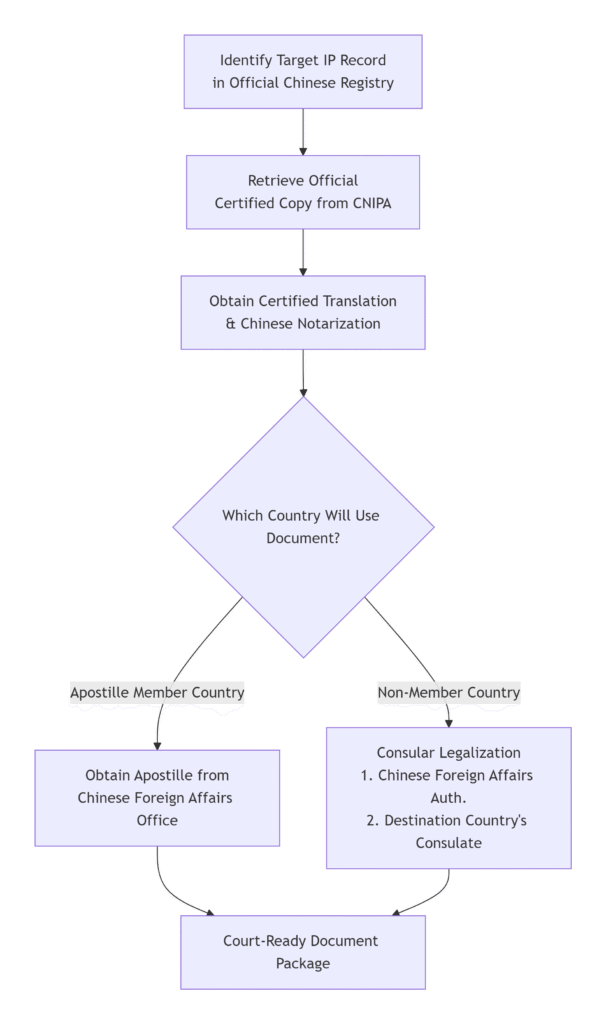
Step 1: Identification and Retrieval
This involves querying the official Chinese databases. The public systems (like CNIPA’s trademark and patent search databases) provide basic information but often only in Chinese. The certified, stamped paper or electronic copies—the ones you need as evidence—must be requested through proper channels. This often requires a formal application, sometimes by a local agent, and involves fees.
Step 2: Translation and Notarization
For use overseas, documents must be translated by a certified translator. This translation is then attached to a copy of the original Chinese document. A Chinese notary public then performs a notarization, certifying that the copy is a true replica of the original and that the translation is accurate. This creates a “Notarized Translation” bundle.
Step 3: Authentication for International Use
This is where many workflows stumble. China is a member of the Apostille Convention (under the “Legalization” chapter). However, the process has two tracks:
- For Apostille Member Countries: The notarized document must be sent to the Foreign Affairs Office of the relevant Chinese provincial government (where the notary is located) or the Ministry of Foreign Affairs in Beijing for an “Apostille” sticker. This verifies the notary’s seal/signature.
- For Non-Member Countries: After notarization, documents require a two-step “consular legalization”: authentication by the Chinese Foreign Affairs Office, followed by further authentication by the consulate of the country where the document will be used.
The Entire Process Can Be Visualized Like This:
Common Pitfalls and How to Avoid Them
- Assuming Online Data is Sufficient: Public databases are for reference. They lack the official seals and verifiable chain of custody required by courts.
- Ignoring Legal Status History: A trademark may look registered online, but a history report could reveal an unresolved opposition that jeopardizes its validity.
- Incorrect Authentication Chain: Using the wrong authentication path (e.g., trying to get an Apostille for a document destined for a non-member country) causes costly delays.
- Timing and Deadlines: The entire process—retrieval, translation, notarization, authentication—can take weeks. This must be factored into litigation or transaction timelines.
Streamlining the Process for Your Firm
Given the complexity, many international law firms partner with specialized local providers in China. An ideal partner should offer:
- Direct Access to Official Channels: Ability to obtain certified copies from CNIPA and copyright offices promptly.
- End-to-End Service: Handling the entire workflow from retrieval to authenticated document delivery.
- Expertise in Legalization Paths: Clear guidance on whether Apostille or consular legalization is needed for your specific target country.
- English-Language Interface and Reporting: Removing the language barrier from the process entirely.
For instance, a comprehensive Intellectual Property Query Service can deliver the official documents you need, while a dedicated Apostille & Legalization Service ensures they are processed correctly for international acceptance. This turns a logistical headache into a streamlined, predictable administrative task, allowing your legal team to focus on strategy and advocacy.
In cross-border disputes, the quality of your evidence preparation can make or break a case. By understanding the system and leveraging the right resources, your firm can transform the challenge of obtaining Chinese IP evidence into a reliable, repeatable advantage.
ChinaBizInsight
Your strategic bridge to transparent business in China.