
If you’re exploring business opportunities in China, you’ve probably heard how crucial it is to “know your partner.” But what does that really mean? And how can you access reliable, official data about a Chinese company without getting lost in translation or bureaucracy?
Enter the Chinese Enterprise Credit Information Publicity Report—a foundational document that serves as the starting point for any serious due diligence on a mainland Chinese company.
In this guide, we’ll break down everything you need to know about this report: what it is, why it matters, how to interpret it, and how it fits into a broader due diligence strategy.
What Exactly Is the Enterprise Credit Information Publicity Report?
The Enterprise Credit Information Publicity Report (企业信用信息公示报告) is an official business profile issued by China’s National Enterprise Credit Information Publicity System (国家企业信用信息公示系统). This system is maintained by the State Administration for Market Regulation (SAMR), China’s primary corporate regulatory authority.
Think of it as the Chinese equivalent of a company’s “birth certificate” and “health record,” rolled into one. It contains the core registration and operational details that define a company’s legal identity and compliance status.
This report is:
- Official – It carries the watermark and logo of Chinese authorities.
- Public – Anyone can access it online (though the interface is in Chinese).
- Authoritative – It is the most widely recognized document for verifying a company’s legitimacy.
Why This Report Is a Must-Have for International Partners
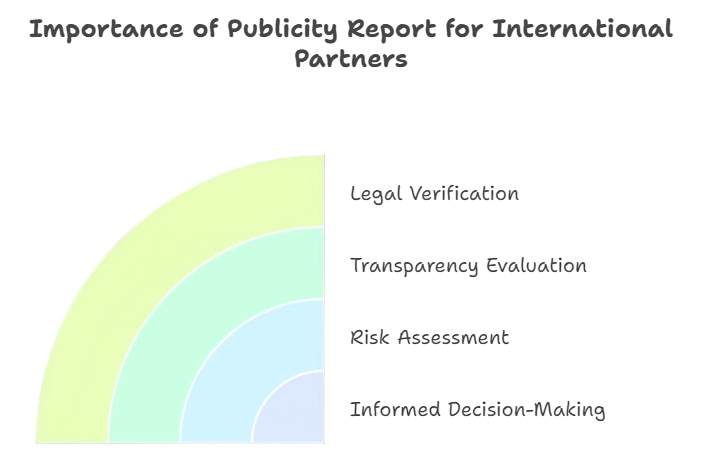
For overseas businesses, this report is often the first step in validating a potential partner, supplier, or acquisition target. Here’s why:
1. Verify Legal Existence and Identity
It’s surprisingly common for foreign companies to encounter shell entities, fraudulent operators, or unregistered “companies.” The Publicity Report confirms whether a company is legally registered, its registered address, legal representative, and business scope.
2. Assess Operational Transparency
The report reveals whether a company has filed its annual reports, paid its taxes, and adhered to regulatory requirements. Missing or inconsistent filings can be a major red flag.
3. Uncover Key Risks
While not a full risk report, it includes data on administrative penalties, pledged assets (e.g., equipment used as loan collateral), and even social security contributions—all indicators of operational health.
4. Support Decision-Making
From negotiating contracts to applying for loans, this report is often requested by banks, law firms, and government agencies as proof of a company’s legal standing.
What’s Inside the Report? A Section-by-Section Breakdown
A typical Enterprise Credit Information Publicity Report includes the following sections:
1. Basic Registration Information
- Company name in Chinese and English (if registered)
- Unified Social Credit Code (USCI) – the company’s unique ID
- Legal representative
- Registered capital and paid-in capital
- Business term and scope
- Registration status (e.g., active, revoked, dissolved)
2. Shareholders and Capital Contribution
- List of shareholders (individuals or entities)
- Contribution amounts and forms (cash, in-kind, intellectual property, etc.)
- Timing of contributions (helpful for verifying compliance with China’s 5-year capital injection rule under the Company Law)
3. Key Personnel
- Directors, supervisors, and senior managers
- Changes in leadership over time
4. External Investments
- Subsidiaries or joint ventures where the company holds equity
5. Administrative Penalties
- Records of fines, sanctions, or violations issued by government agencies
6. Pledged Assets
- Details of assets used as collateral for loans
7. Social Security Information
- Number of employees enrolled in social security—a useful indicator of actual operational scale
8. Annual Reports
- Summary of yearly disclosures submitted to SAMR
How to Get the Report (And Why It’s Not Always Easy)
The report is publicly accessible at gsxt.gov.cn, the official National Enterprise Credit Information Publicity System portal. However, overseas users often face several hurdles:
- Language Barrier – The portal is entirely in Chinese.
- Access Issues – The site may be slow or inaccessible from certain regions.
- Technical Challenges – Captcha verification and ID requirements can block foreign users.
- Interpretation Difficulty – Even if you get the report, understanding the context and implications of each field requires local expertise.
That’s where specialized service providers like ChinaBizInsight come in. We help international clients obtain, translate, and interpret these reports accurately—saving you time and ensuring clarity.
Beyond the Publicity Report: When You Need More Depth
While the Publicity Report is essential, it has limitations. It doesn’t include:
- Financial statements (though some companies voluntarily disclose them)
- Detailed legal proceedings
- In-depth operational or reputation analysis
- Real-time ownership structures
For high-stakes decisions—like mergers, acquisitions, or large-scale partnerships—you’ll need more comprehensive due diligence. This is where customized credit reports come into play, such as:
- Standard Business Credit Report – Expands on the Publicity Report with legal and operational risk analysis.
- Professional Enterprise Credit Report – Includes 11+ dimensions of due diligence, from supply chain to litigation history.
- Financial & Tax Report – Focuses on financial health, tax compliance, and invoice data.
These reports are especially useful for investors, lenders, and legal advisors who need a 360-degree view of a company’s credibility.
Case in Point: Screening a Top Chinese Private Enterprise
Let’s say you’re considering a partnership with one of China’s leading private companies—like Huawei, BYD, or JD.com. You’d start with their Publicity Report to confirm registration details and check for penalties. But given their scale, you’d also want to:
- Verify group structure and subsidiaries
- Assess intellectual property portfolios
- Review financial performance and debt levels
For example, the 2025 list of China’s Top 500 Private Enterprises (which you can download below) shows companies with a minimum revenue of ¥270 billion (~$37 billion). Due diligence at this level requires more than a basic report—it demands a tailored approach.
How to Use the Report in Your Workflow
Here’s a simple due diligence checklist for international partners:
- Start with the Publicity Report – Confirm the company’s legal existence and basic compliance.
- Review annual filings – Check for consistency and transparency.
- Look for red flags – Penalties, overdue contributions, or ownership opacity.
- Upgrade when needed – For investments or large contracts, opt for a Professional Enterprise Credit Report.
- Authenticate documents – If the report will be used overseas, consider Apostille or legalization for cross-border recognition.
Wrapping Up: Your Trust Starts with Transparency
In today’s globalized economy, partnering with Chinese companies offers immense opportunity—but it requires trust backed by data. The Enterprise Credit Information Publicity Report is your first and most important step toward building that trust.
It’s not just a document; it’s a window into your potential partner’s legitimacy, compliance, and operational integrity. And with the right support, you can navigate China’s business landscape with confidence.
🔗 Download the 2025 List of China’s Top 500 Private Enterprises
👉 Click here to access the full list
Need a Reliable Chinese Company Report?
If you’re looking to verify a business partner in China, start with an Official Enterprise Credit Report. For deeper insights, explore our Professional Enterprise Credit Report, which includes legal, operational, and financial analysis.
ChinaBizInsight
Your strategic bridge to transparent business in China.