Introduction
If you’re exploring business opportunities in China, you’ve likely come across the term “private enterprises.” But what exactly are Chinese private enterprises? How do they differ from state-owned companies? And why are they such a critical force in the world’s second-largest economy?
In this guide, we’ll break down everything you need to know about Chinese private enterprises—from their legal identity and economic impact to the latest rankings of the top players. We’ll also provide you with a free downloadable list of the 2025 Top 500 Chinese Private Enterprises to help you identify potential partners, competitors, or investment opportunities.
Whether you’re a investor, entrepreneur, or business professional, understanding this dynamic sector is key to navigating the Chinese market with confidence.
What Are Chinese Private Enterprises?
Chinese private enterprises are businesses founded, owned, and operated by private individuals or non-governmental entities. Unlike state-owned enterprises (SOEs), which are controlled by the government, private enterprises operate under market principles with minimal state intervention.
These companies range from small family-run businesses to massive multinational corporations. They operate across various industries, including technology, manufacturing, e-commerce, finance, and more.
Key Characteristics:
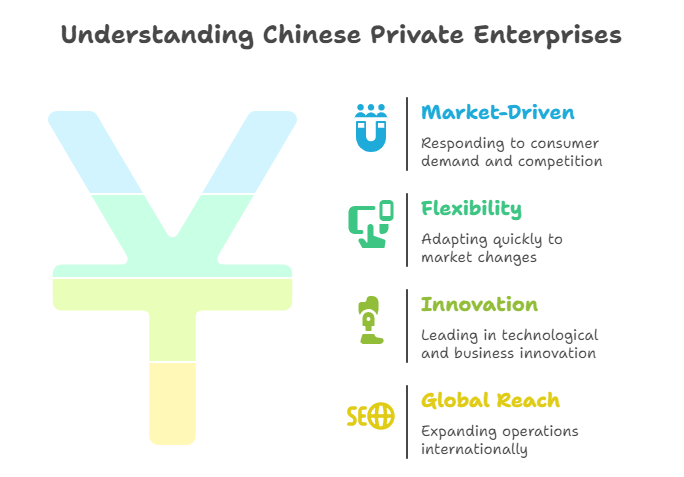
- Market-Driven: They respond to consumer demand and compete freely.
- Flexibility: They often adapt more quickly to market changes than SOEs.
- Innovation: Many of China’s most innovative companies are privately owned.
- Global Reach: An increasing number are expanding internationally.
Legal Status and Recognition
Under Chinese Company Law, private enterprises are recognized as legal entities with clearly defined rights and responsibilities. The latest revision of the law, effective July 1, 2024, further standardizes corporate governance and protects shareholders’ interests.
Most private enterprises in China are structured as:
- Limited Liability Companies (LLCs)
- Joint Stock Companies
They are required to register with the State Administration for Market Regulation (SAMR) and disclose key information through the National Enterprise Credit Information Publicity System.
Economic Contribution
Private enterprises are the backbone of China’s economy. Consider these facts:
- They contribute over 60% of China’s GDP.
- They account for more than 80% of urban employment.
- They represent 90% of all market entities in China.
In 2024, the total revenue of the Top 500 Chinese private enterprises reached ¥43.05 trillion (approx. $6 trillion USD), reflecting a steady growth trajectory despite global economic uncertainties.
The 2025 Top 500 Chinese Private Enterprises List
Each year, the All-China Federation of Industry and Commerce (ACFIC) releases a list of the top 500 private enterprises in China based on annual revenue. This list is a vital resource for anyone interested in the Chinese market.
Key Highlights from the 2025 List:
- The threshold for entry rose to ¥27.023 billion (approx. $3.8 billion USD).
- 105 companies reported revenues exceeding ¥100 billion.
- The top sectors include manufacturing, technology, and wholesale/retail.
Top 10 Companies in the 2025 List:
- JD.com
- Alibaba (China) Co., Ltd.
- Hengli Group
- Huawei Investment & Holding
- BYD
- Tencent
- Zhejiang Rongsheng Holding
- Zhejiang Geely Holding
- Shenghong Holding
- Shandong Weiqiao Pioneering Group
📥 Download the Full List:
2025 Top 500 Chinese Private Enterprises (Excel)
Why This List Matters for International Businesses
This list isn’t just a ranking—it’s a window into China’s most influential and rapidly growing companies. Here’s how you can use it:
- Identify Potential Partners: Find reliable suppliers or joint venture partners.
- Competitor Analysis: Understand who’s leading in your industry.
- Investment Insights: Spot high-growth companies for investment opportunities.
- Market Trends: See which sectors are booming.
How to Verify a Chinese Private Enterprise
Before engaging with any Chinese company, it’s essential to conduct due diligence. Many overseas businesses face challenges such as:
- Lack of transparent information
- Difficulty verifying business legitimacy
- Language and regulatory barriers
This is where professional business verification services come in. At ChinaBizInsight, we specialize in providing official enterprise credit reports, due diligence profiles, and background checks to help you make informed decisions.
For example, our Standard Business Credit Report includes key details such as:
- Business registration status
- Shareholder structure
- Legal records
- Financial performance
Conclusion
Chinese private enterprises are dynamic, innovative, and central to China’s economic story. Understanding who they are, how they operate, and which companies lead the market can significantly enhance your business strategy in China.
We hope this guide—and the downloadable Top 500 list—helps you take the next step toward successful engagement with Chinese businesses.
If you need deeper insights into any company on the list, consider ordering a customized credit report or comprehensive due diligence profile to ensure you have all the information you need.
Written by: ChinaBizInsight Team
Connect with us: Contact Page | All Services
ChinaBizInsight
Your strategic bridge to transparent business in China.