
For foreign businesses operating in China, protecting intellectual property rights often involves navigating complex legal procedures. One critical tool is patent invalidation – a process to challenge and potentially cancel a granted patent before the China National Intellectual Property Administration (CNIPA). Understanding this process is vital when facing infringement allegations or market barriers due to questionable patents. This guide details the practical steps for evidence collection and oral hearing strategies.
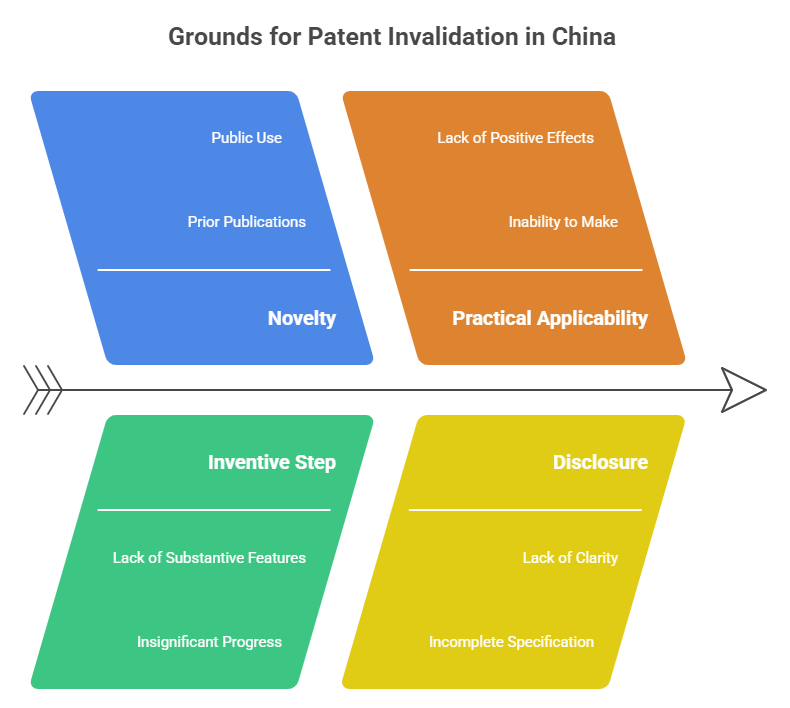
I. Grounds for Patent Invalidation in China
The Patent Law (Articles 22, 23, 26.3-4, 33) specifies grounds for invalidation. Common bases include:
- Lack of Novelty: The patented invention/design was publicly known before the filing date (e.g., prior publications, public use, sales).
- Lack of Inventive Step (Non-obviousness): The invention, compared to existing technology, lacks prominent substantive features and represents significant progress.
- Lack of Practical Applicability: The invention cannot be made or used industrially or fails to produce positive effects.
- Insufficient Disclosure: The patent specification lacks clarity and completeness, preventing a skilled person from implementing the invention.
- Amendments Exceeding Scope: Amendments during prosecution went beyond the original disclosure.
- Unpatentable Subject Matter: Falls under exclusions like scientific discoveries, rules/methods for mental activities, or methods for diagnosis/treatment of diseases (Art. 25).
- Lack of Distinctiveness (Designs): The design is not sufficiently distinguishable from prior designs or combinations thereof.
II. Strategic Evidence Collection: Building Your Case
Effective invalidation hinges on robust evidence. Key sources and strategies include:
- Prior Art Searches: This is paramount.
- Global Databases: Search CNIPA’s patent databases, WIPO’s PATENTSCOPE, USPTO, EPO Espacenet, and commercial databases like Derwent Innovation or Orbit.
- Non-Patent Literature: Academic journals (IEEE, ScienceDirect), conference proceedings, technical standards, product catalogs, technical manuals, dissertations. Don’t overlook Chinese-language sources.
- Public Use/Sale Evidence: Sales invoices, contracts, dated product brochures, dated advertisements (print/online), witness statements corroborating public use before the patent’s filing date. Provenance and clear dates are crucial.
- Internet Archives: Use the Wayback Machine (
archive.org) to prove the public availability of web pages, product listings, or technical information predating the filing date.
- Evidence Demonstrating Lack of Inventive Step:
- Combine prior art references to show the claimed invention was obvious. Focus on the technical problem solved and why the combination would have been logical to a person skilled in the art at the time.
- Expert declarations can be persuasive in explaining technical common knowledge and why the combination is obvious.
- Evidence for Insufficient Disclosure:
- Detailed technical analysis showing key elements are missing, ambiguous, or contradictory within the specification.
- Experimental reports attempting and failing to replicate the invention based solely on the patent description.
- Evidence for Amendments Exceeding Scope:
- Compare the granted claims/specification meticulously with the original application documents filed. Highlight added subject matter not originally disclosed.
- Formal Requirements:
- Translation: Non-Chinese evidence must be accompanied by a certified Chinese translation.
- Authentication/Notarization: Public documents generated outside China (e.g., commercial invoices, official publications) often require notarization and legalization (or Apostille under the Hague Convention) to be admissible.
- Dated Proof: Evidence must irrefutably prove public availability before the Chinese patent’s filing date (or priority date if claimed).
- Organization: Present evidence logically, indexed, and cross-referenced in your invalidation request.
III. Navigating the CNIPA Oral Hearing
If the CNIPA Invalidations Division (复审和无效审理部) deems your request has merit, an oral hearing is scheduled. Preparation is key:
- Pre-Hearing Preparation:
- Review Panel’s Preliminary Views: Carefully analyze any preliminary opinion issued by the panel. Understand their key concerns.
- Refine Arguments & Evidence: Focus your arguments on the panel’s questions and the strongest grounds/evidence. Prepare visual aids (charts, claim comparison tables, technical diagrams).
- Prepare Witnesses/Experts: If using them, ensure they understand the process and can clearly explain technical points under questioning. Coordinate testimony with your main arguments.
- Rehearse: Practice presenting key points concisely and anticipate potential counter-arguments from the patentee.
- During the Hearing:
- Structure: Typically involves petitioner presenting case, patentee responding, followed by debate and panel questioning. Stick to allotted times.
- Clarity and Conciseness: Present arguments logically and clearly. Avoid legalese where plain technical language suffices. Focus on the core issues.
- Address the Panel: Direct arguments to the panel members, not the opposing party. Answer their questions directly and respectfully.
- Evidence Presentation: Refer to specific evidence clearly (e.g., “See Exhibit D3, page 2, paragraph 3”). Use visuals effectively.
- Rebuttal: Listen carefully to the patentee’s defense and be prepared to counter their points directly with evidence or reasoning. Avoid personal attacks; focus on facts and law.
- Expert Testimony: Ensure experts stick to technical facts within their expertise and avoid legal conclusions.
- Post-Hearing:
- Supplementary Submissions: Submit any additional materials requested by the panel promptly. Avoid introducing entirely new arguments or evidence without permission.
- Await Decision: CNIPA decisions usually take several months after the hearing.
IV. Practical Tips for Success
- Act Promptly: File invalidation requests strategically. While non-malicious invalidation requests can be filed anytime, challenging patents early in infringement disputes is often crucial (Art. 45 Patent Law).
- Seek Expert Guidance: Navigating CNIPA procedures, especially complex technical arguments and hearings, benefits immensely from experienced Chinese patent attorneys or agents. They understand the nuances of practice and examiner expectations. For comprehensive support in gathering crucial prior art documentation from Chinese and international sources, consider specialized intellectual property verification services.
- Quality Over Quantity: Focus on the strongest 1-2 invalidity grounds backed by the most compelling evidence. A scattergun approach dilutes your case.
- Understand CNIPA Practice: Be aware of CNIPA’s specific interpretations of novelty, inventive step, and disclosure requirements, which can sometimes differ subtly from other major patent offices.
- Consider Settlement: If the evidence is strong, the patentee may be open to negotiation (licensing, settlement) before or during the invalidation process.
Conclusion
Patent invalidation in China is a powerful but complex legal tool. Success demands meticulous evidence gathering – particularly rock-solid prior art demonstrating lack of novelty or inventive step – coupled with rigorous adherence to procedural rules and persuasive advocacy during the oral hearing. While the process is challenging, a well-prepared invalidation action based on solid grounds and evidence can effectively remove unwarranted patent barriers, safeguarding your market freedom and competitive position in China. Given the high stakes and procedural intricacies, partnering with seasoned professionals is often indispensable for achieving a favorable outcome.
ChinaBizInsight
Your strategic bridge to transparent business in China.